Thursday, 12 January 2023

Bohemian Chapels and Shrines

Today's post shows the various chapels and shrines I built for the Bohemia 1866 setup. The land was crammed with such Catholic symbols, in villages and by the roadside. In this post they are something of a prop for more of my heavily-converted 1866 figures.

We start with a chapel, made by the "cannibalise a plastic kit" method discussed last time. The gun is a 12-pounder smoothbore of the Saxon horse artillery. The Prussians and pretty much all the German states equipped their horse artillery with such guns, fancying they would mount "grapeshot charges", but the tactic was a non-starter in the face of Austrian rifled artillery.

Another chapel, made in the same sort of way. This gun is a Saxon 6-pound rifled breechloader. The foot artillery of all the German states comprised these pieces and smoothbore 12-pounders, in a 50:50 mix. The 6-pounder barrels were made by Krupp, but each state built its own carriages to mount them on.

Even a village might have a religious statue like this. The figure on top came from the Faller set of religious details. Austrian Jaegers pose by the statue. I converted them from Perry ACW firing line guys. There is a teeny bit of evidence that, unlike the line infantry, the Jaegers sometimes fought in their "proper" uniform rather than the drab greatcoat, so I needed no more excuse.

Here a Saxon general and a mounted colonel pass a little model of a cross and a "village bell". Bohemian villages, presumably the ones lacking a church, invariably had such a bell. I think its function was to summon the villagers in the event of a fire or whatever.

Saxon Jaegers fight there way into a Bohemian village, past one of the many varieties of shrine. You may just be able to make out a statue behind the grille. The figures started life as plastic French Napoleonic voltigeurs.

Another village, another shrine, another battalion of Saxon Jaegers. 

And another shrine, this one recognisably in the local version of Baroque style. Beside it stands the the commander of my 1866 Prussians, General von Steinmetz. He wears his famous oilcloth-covered field cap, which he'd worn in the Napoleonic wars as a young officer! Steinmetz was a dead loss in the Franco-Prussian War, but in 1866 he was the hero of the army. He led his V Corps to defeat three successive Austrian corps on three successive days, whilst uttering bon mots under the heaviest fire! Accompanying him are his chief of staff and a dismounted officer of the Guard Cuirassiers. The latter wears an odd but characteristic outfit: bronzed cuirass, field cap, high boots and a frock coat turned back in Seven Years War style! His horse is held by a trooper of the Feldgendarmerie.

The heroes of the Austrian army were the gunners. Here we have a the massed corps artillery: a 4-pounder battery, a double battery of 8-pounders, a double battery of horse 4-pounders, the rocketeers and the artillery commander. These two shrines are mounted on pins.


Sunday, 1 January 2023

A Chateau in Bohemia


Happy New Year!

I hope you had a good Christmas. Happy New Year at any rate. I have been laid low by the virus that everyone around has been getting. Is it Covid, flu or some nameless monster bug? Doesn't seem to make much difference at this late stage of the pandemic. I've had worse flu in the past, so it's nothing like the lethal early variants of Covid, but you get a kalaidescope of symptoms from day to day, linked throughout only by low mood and zero energy. Anyway, I'm about as normal as I get now, so on we go with the next photos from 1866 Bohemia.

Review of 2022

First a bit of a review  of 2022's hobby activity might be in order. I am a big believer in working towards objectives, and I set myself three for the year: Franco-Prussian War rules, finishing the armies for that period and making a really good (teddy-bear fur) cloth to cover my table. And then two other priorities forced their way onto the list: Franco-Prussian buildings and two more artillery masters for Michael Perry. This last job was the only one of the five targets definitively ticked off, the masters being handed over six months ago now. The cloth project has got nowhere as yet, although I have the beginnings of a flexible system of hills to lay beneath it (which I'll talk about another time). So that leaves three goals on which there's been concrete progress, but there's some distance to go as yet. 

Firstly the FPW rules. This time last year only concepts existed and a fully playable set has seen action maybe a dozen times since then. It's fully typed up and copies have been sent to those of you who asked. Feedback was received and incorporated from Garry Broom, Adrian Hussey, Nathan Paxton, Jonathon Marcus and Martin Gane. I did approach Richard Clarke of Too Fat Lardies with a view to discussing publication. He said at the very least he'd read them and give me feedback, which I would very much have welcomed. Sadly he then decided it wasn't a commercially viable period for the investment required and never gave me any feedback. Which I thought was rather disappointing of him. I have faint ideas of  approaching maybe Helion or someone. I'm still slowly refining the rules, so we'll see. Actually, I should say, I am quite chuffed with getting these rules done, because I had wondered whether my ageing brain would be up to it. Well it is. So far. Touch wood!

The main job as regards finishing Franco-Prussian armies is to do the staff. Because of the army level at which the game is set, we need command groups for armies, corps, divisions and a few lesser folk. Although our forces for this war are made up from the old Foundry range, we thought that staff from the new Perrys range would be reasonably compatible. Sadly 2022 has seen only a single pack of Prussian "high command" released, half of which are completely inaccurate (sorry to moan). So we can't do anything for the French as yet, whilst German command groups will be "heavy" conversions. At least I've done the necessary figures for the Bavarian corps, which you've seen. The Prussians will be feasible, but any French will have to wait for some actual releases for that army.

Finally, as you have seen I've built a few earthworks and two chateaus for this period. There's another chateau planned, plus village buildings and some other bits and bobs such as railway lines and vineyards. 

Apart from these making and painting targets, I have kept this blog going, with some 40 posts in 2022. There's been some great feedback and comments from readers, and I've been able to provide advice to a number of people with scenery projects of their own. Some of this has been via email rather than comments on the blog, which is fine. I have now photographed almost all of my earlier projects and after about another four posts on Bohemia, it will be current work and the long-promised tutorials. 

The Bohemian Chateau

Right, back to the nitty-gritty. I built this chateau some ten years ago. Unlike the recent  French baroque effort which was a major scratch-build, this building was a sort of conversion, a "mash-up" perhaps, of a model railway kit. The original was Baden-Baden railway station, an HO (1:96) production from Vollmer, which you can easily find online if you're interested. I was lucky enough to find a half-made, grotty version of this kit being sold cheap at a model railway show some years earlier, and had thought it might be the makings of something grandiose one day. 

The technique of taking a model railway kit and using it to make a wargames model of a somewhat different scale was one of the useful things invented by the late Peter Gilder. These kits can provide a ton of useful detail such as windows and ornamentation. The two buildings in my last post both got their roofs from plastic kits. Mostly you have to buy these kits new and they aren't particularly cheap (though Ebay may help), but they save a lot of time and can provide something different, plus it's a good approach for the less confident modelmaker. Simon Chick ran with this approach, as you may see on his Je Lay Emprins blog (link in right-hand column). The key thing, which Peter Gilder noted, is to get at least the ground floor and any doors to a height that looks something like compatible with the figures you are going to use. The upper storeys aren't so noticeable. 

In this case, I made the basic walls from scratch, so basically the parts coloured ochre, cutting window openings to fit the kit part and cutting kit details to fit on top. The roof is made from cut-up roof sections of the kit. A few parts such as chimneys and stairs are scratch-built. 

The architectural style of Baden's railway station, and hence this chateau is what's called "rococo". This look was an ornamental development of the baroque style we have talked about before, starting in  France during the early eighteenth century. For some reason it lasted longest in Germany, and hence the Austrian Empire. Rococo style is fussy and flowery, cupids being the signature detail!


Here Austrian uhlans and hussars show off their own fussily-detailed style. Although to be fair there's no cupids.

An Austrian Grenz regiment, in this case Number 13 Roman-Banat. Grenz infantry had been classed as light troops right up to the war of 1859, but in 1866 were just seen as slightly unreliable line troops and mostly used for garrisons. The parade uniform had brown tunics, which you only see on the officer here.


The Austrian rocket launcher used in 1866. By this time they worked on the unspectacular Hales system, ie spin stabilised, no longer the "firework rocket" approach. Also by this time rifled artillery had made the rockets relatively short-ranged. They hoped for a certain morale effect, but this was lost on the stolid Prussians! The only remaining advantage from this weapon system was that it was transported by pack mules, so could go up mountains and through woods unlike conventional artillery.


Austrian gunners run up a 4-pounder. Conversions from Perrys ACW gunners. These pieces were the final and optimal development of bronze muzzle-loading artillery. All the barrel-bands, dolphins and the rest of it were stripped away, leaving a simple, accurate, long-ranged and very light artillery piece. 


Thursday, 8 December 2022

Battles in Bohemia

After a little interlude, here is the next installment of stuff I made for the war of 1866 in Bohemia. To add interest I have posed the buildings with figures of both armies that I converted and painted.


The first building is what's called a Speicher in German, meaning a food store, meant to protect grain and other foodstuffs from damp and vermin. You get them in Bohemia and some parts of Germany. The principle is that the ground floor is built of stone and has no outside access. The only door is upstairs, accessed by steps, and there would be internal stairs leading down to the ground floor and up to another floor. The troops here are an Austrian 4-pounder, Infantry Regiment 15 and a brigade command group. The gun is scratchbuilt and the figures are all heavy conversions.

The roof of the Speicher was created out of a shingle roof from some German model railway kit. The infantry regiment is that named after the Duke of Nassau, whose name (Hzg. v. Nassau) you can see on the flag cover, worn over the standard-bearer's shoulder. As well as the general splendour of the Austrian colours, each had a magnificent collection of streamers and tassles. These figures started as Helion/ Northstar, but at the time they only had Hungarian infantry, so the trousers are done with Greenstuff. The arms and rifles come from a Perrys plastic ACW set.

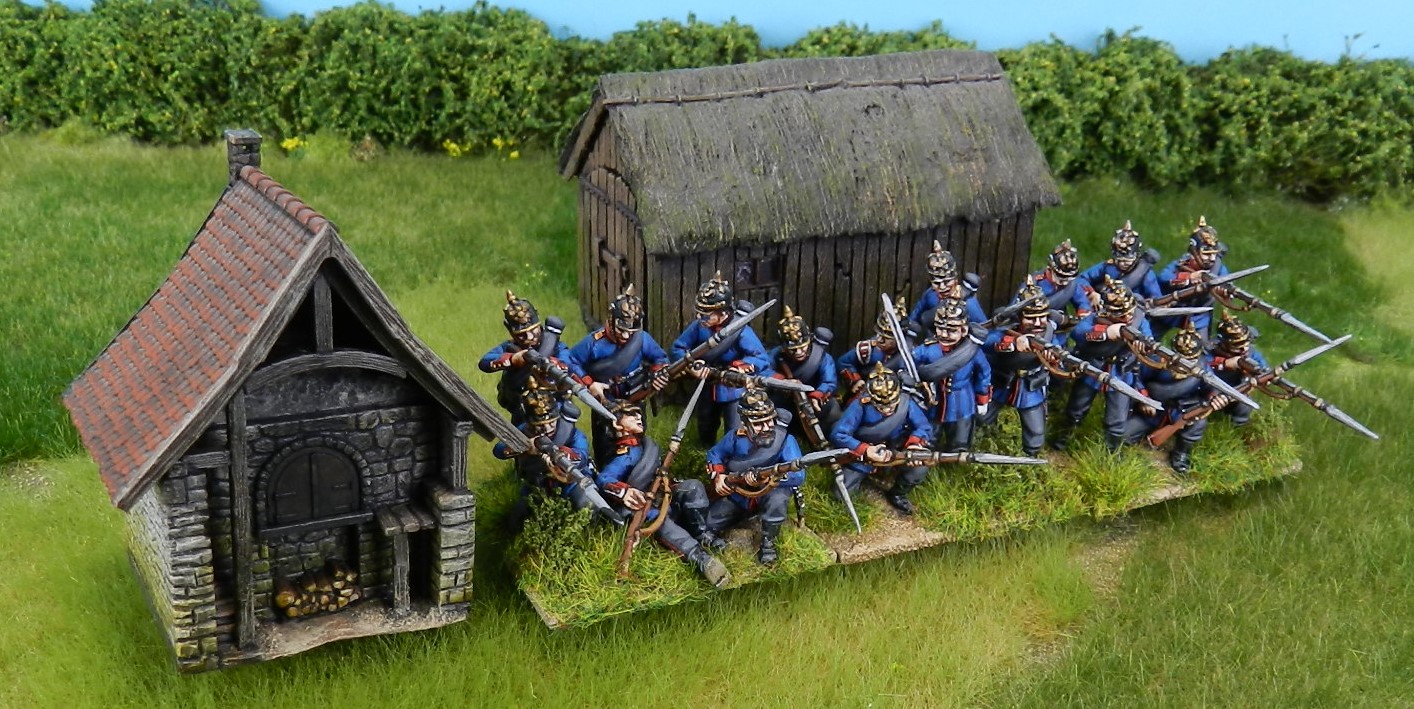
Back to the Prussians. This is the other unit I did recently from the new Perry plastics, here in firing line poses. The sitting casualty figure is a North Star one, blended in with Perry details. The little buildings here are a bread oven and a planked shed, both mainly from German model railway items again. To be honest I don't really know if they had freestanding bread ovens in Bohemia, but it was such a nice model and compatible with the other buildings.

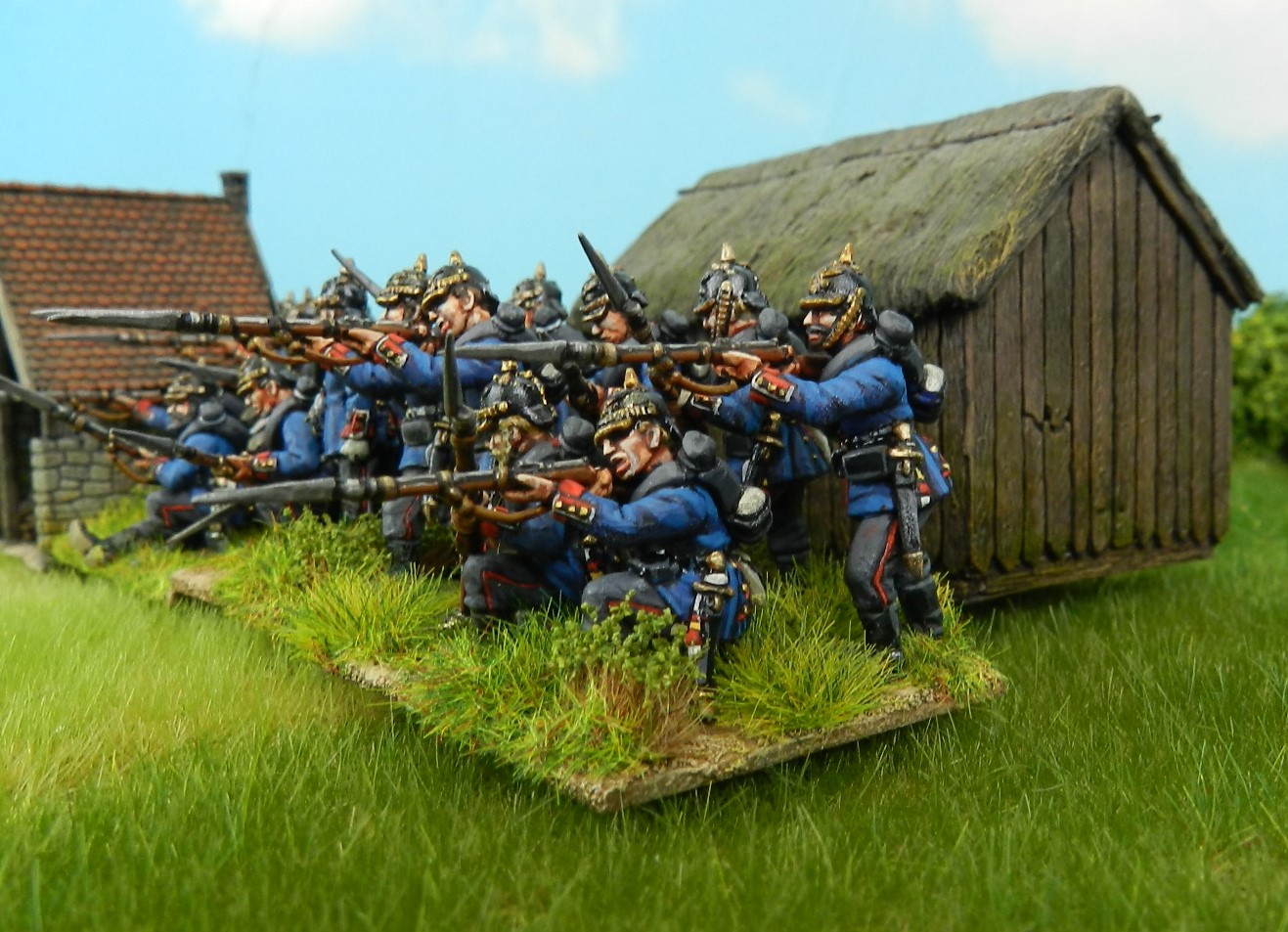
A closer shot of the Prussians. I do like to go to town with the bases these days, adding foliage tufts, long grass tufts and blending them in with static grass. I take a perverse delight in squeezing six figures and half the landscape onto each 45mm x 40mm base, because I have a downer on the modern trend for gi-normous bases, "overbasing" as I call it!

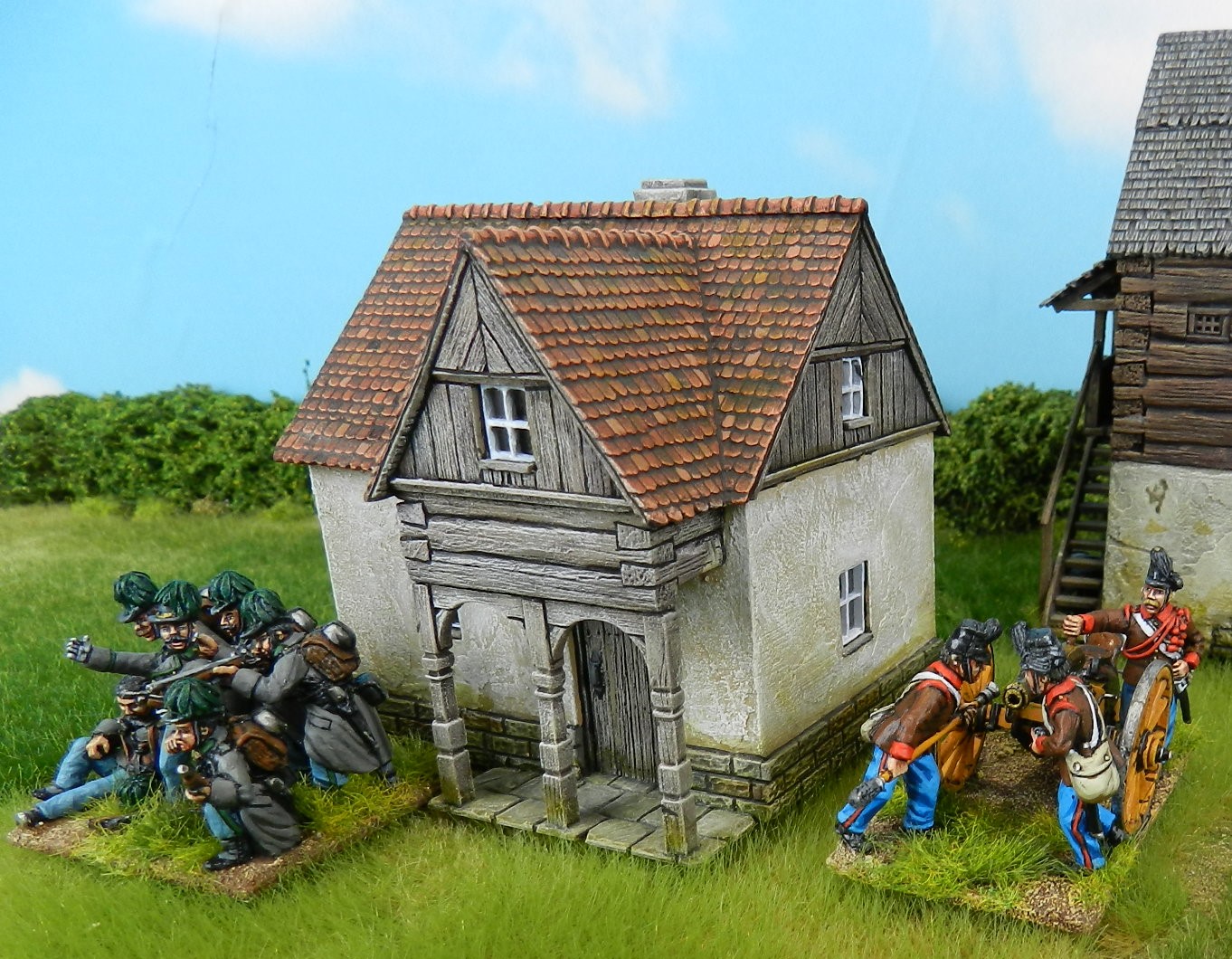
Here we have another feature of the Bohemian rural scene, a village inn. The portal or whatever you'd call it is common to virtually all inns there, and because they were thus marked out they mostly didn't bother to have a particular sign. This is odd, but it's what my research found. The hostelry is posed with a 4-pounder in aiming mode and a Jaeger battalion. I think these started life as Perrys Carlist War figures, but I did sculpt and cast my own heads for the very distinctive headgear.

The gun here is in loading mode, with the NCO "thumbing the vent". Junior NCO's wore this impressive arrangement of cords and pom-poms. The artillery branch of service was for centuries the pride of the Austrian army, and they did outstanding service in 1866, when the Prussian artillery was a bit rubbish. Something the Prussian/ German army was good at however was learning the right lessons, and they copied the Austrian artillery's methods in 1870, to decisive effect.

No sooner had I converted 30 Jaeger figures than North Star released perfectly nice figures for this troop type. so I had to have some of them too. The command base is Colonel Hertwek, who commanded a brigade at the battle of Skalitz bravely, although disastrously. Anyway, here we have the two types of well seen in the area, a well sweep for areas where water was just below the surface and the conventional wind-up type. This specific well was copied from a line drawing in Fontane's history of the campaign. Throughout the desperate action of Burkersdorf a village lad drew water for the hard-pressed Austrian defenders, and nice to relate, the trigger-happy Prussians managed not to injure him. The War of 1866 seems to have been conducted in a thoroughly gentlemanly manner, as wars go.


Monday, 21 November 2022

Bohemian Houses

I'd like to thank people for the kind comments encouraging me to keep going with the blog after I had a moment of doubt. Both the blog's "regulars" and a number of previous "lurkers" took the trouble to post something, which I very much appreciate. 

After a little delay, caused by real-world things as well as by work on my Franco-Prussian War rules, here's the second installment of the set-up built for the Austro-Prussian War of 1866, most of which took place in the land of Bohemia. I made these about 12 years ago, and enjoyed researching what the rural environment of this unfamiliar area looked like. Here's what the houses of all but the most prosperous folk were like, at least in the north-western corner of the land, where the main battles of 1866 happened. Of course this was also where some of Frederick the Great's campaigns had taken place, so the set-up would work equally well for the Seven Years War. Bits of the Thirty Years War too, I suppose. Nor would the houses look out of place for parts of Poland and other parts of eastern Europe.

As this was a hilly, well-wooded area, timber was plentifully available and naturally served as the main material for vernacular building. The construction method here was a variant on the common "log cabin" method. It's called Blockbau in German sources. The logs are roughly squared off, and lock together at the corners by means of three-dimensional dovetail joints. Sometimes the cracks between logs are filled with daub, which is whitewashed to produce a characteristic "zebra stripe" effect. The Blockbau look was hard work to model; I could think of nothing faster than laying balsa logs individually and cutting the joints more or less as in real life. 

The gables were planked, sometimes in decorative patterns, different on each house.

The house on the left shows a couple of the variations you see: the roof is hipped in shape and the walls whitewashed. 

A closer view of the veranda feature.

Two more of the common variations. On the left we have a house where one end is built of rendered stonework and the other of Blockbau. On the right is a house with a shingled roof. The little "bonnets" over the gable ends are another local thing, as are the turned wooden finials, a tiny influence from Baroque style. The thing on the back wall is a fire ladder. If your roof was set on fire by a spark from the chimney, you wanted to get up there quickly and pull off the burning part before it spread. 

Two houses are posed here with the latest unit I have done for my 1866/ 1870 gaming. It's the 7th Prussian regiment, the King's Grenadiers. I've recently done a couple of units with the Perry plastics. I was impressed with the flexibility of the parts, and the accuracy, even if those skinny plastic bayonets look awful vulnerable for gaming.


Thursday, 3 November 2022

Blog Anniversary - A Church in Bohemia 1866

It was exactly one year ago, 3rd November 2021, when this blog got started. Twelve months and seventy-two posts have passed. Now we have the start of a final series of images of my past work, which will show the buildings and scenery made for the Austro-Prussian War of 1866, and some of the figures which battle over them. 

It's been a fair bit of work doing the blog, but overall a rewarding experience. It is widely said now that blogs are a dying medium for showcasing one's work and have been for some years really. The main reason being that if you post pictures on Facebook and other social media then fiendish algorithms will herd viewers and "likes" towards your efforts, which doesn't happen really with a blog. Another factor is the sheer overkill in numbers terms: the Blogs Of War site unbelievably lists over 1500 wargames-related blogs(!)  But many of them are abandoned or only intermittently updated now, even some that were recently vibrant, which I find rather sad. People especially keen on grabbing attention now combine social media with webcam videos, never mind blogs. Fair play to those who are sufficiently tech-ey, and hungry enough for views (or sales), but that isn't me.
The straight facts are that each time I make the effort to photograph my models and carefully write an accompanying text, I like to think I am putting something unique and informative out into the hobby world. And maybe 80 people view it and half a dozen make any comment, which is a bit underwhelming to be honest. So I have had a good think about whether it's a sensible use of my time. But on balance I think it's still worthwhile. There is something satisfying in bulding up a proper chronicle of the modelmaking work I've done over the decades, and that would only be ephemeral on social media. Secondly although the numbers aren't large, the quality of interaction I've had with fellow hobbyists has been nice. Some of it has been via email rather than visible on the blog. I do very much appreciate your comments and occasional questions, and always reply to them. Several people have sent me pictures of their own modelling efforts, more or less inspired by mine. And I have made a couple of  pals from this who I now see in real life, which is great. 
So after this little bit of introspection, on we go! The plan is that once all the Bohemian stuff has been shown (half a dozen posts?), there will only be my latest models to post, as I produce them. However I will then try a tutorial or two, the first being step-by-step how to make nice trees. Hopefully that will spark some further interest. 

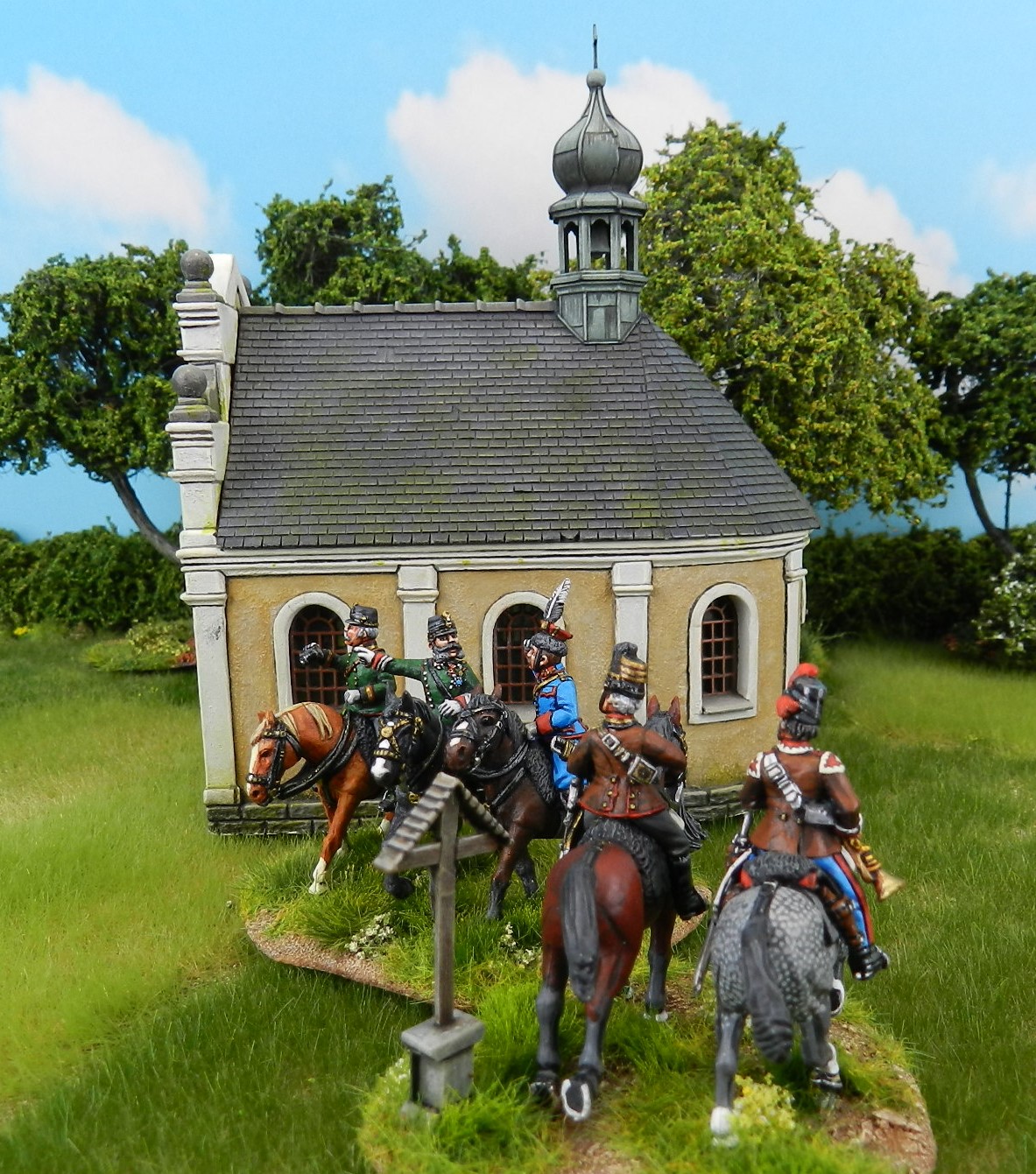
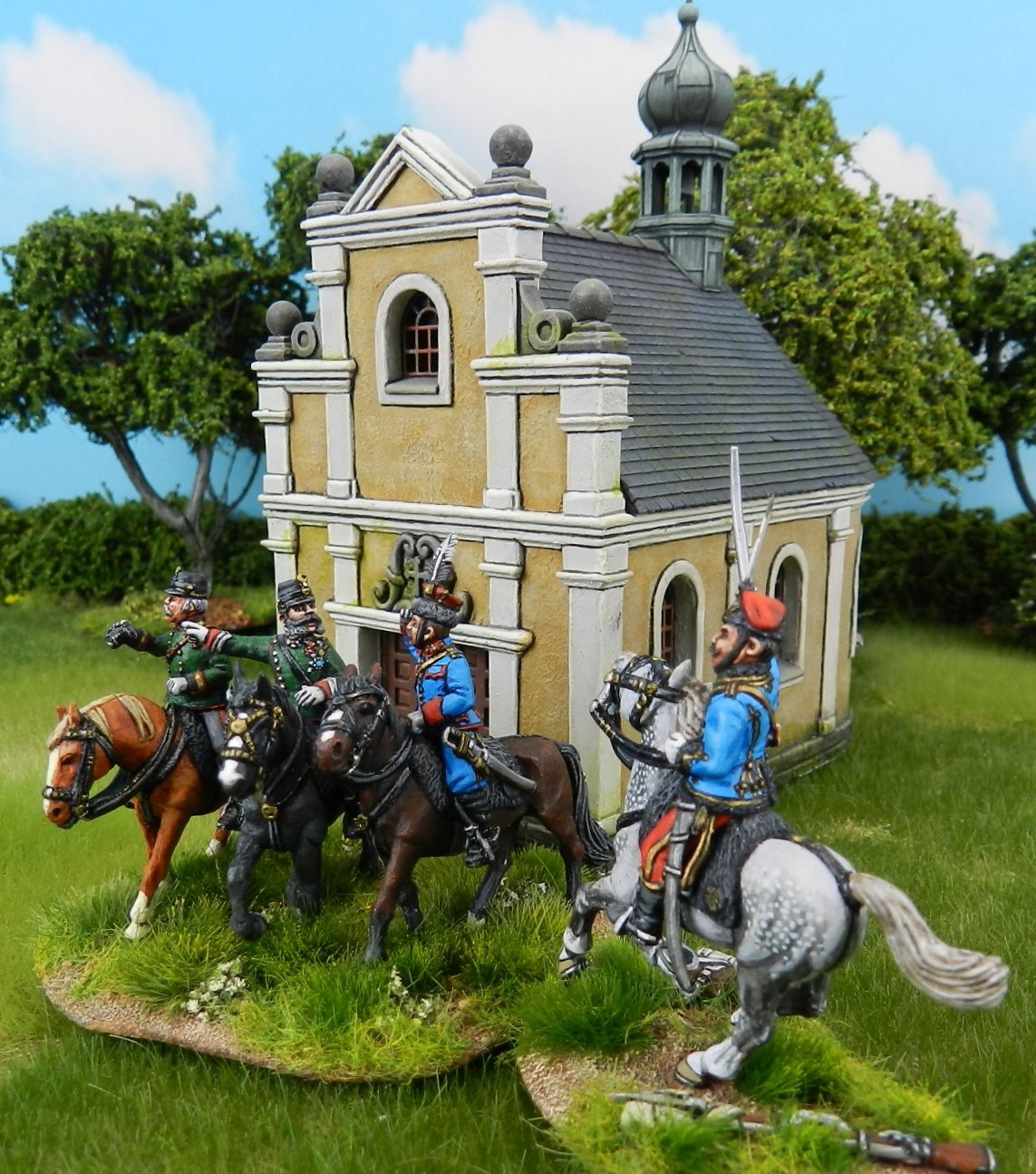
Anyway, here is a typical Bohemian church, posed with the commander of my Austrian forces, Feldmarschalleutnant (Lieutenant general) von Gablenz.

Gablenz was the best of the Austrian corps commanders in 1866. A dashing, dandified fellow, his soldierly qualities were too much for his Prussian opponent at the Battle of Trautenau, the only clear Austrian victory of the war. The Austrians suffered four or five times as many casualties against the Prussians' breechloaders, but hammered at the the latter until they gave up and retreated all the way back out of Bohemia. Here Gablenz wears his campaign dress as colonel-in-chief of an Uhlan regiment, and I was able to model him with the exact medals and orders he posessed at this date. Next to him is his chief of staff, and an Uhlan aide in the new-style light blue uniform salutes before galloping off with orders. In the foreground is X Corps' artillery commander, colonel Eisler, and a battery trumpeter. These figures are all heavy conversions, starting with North Star metals and Perry Napoleonic plastics.

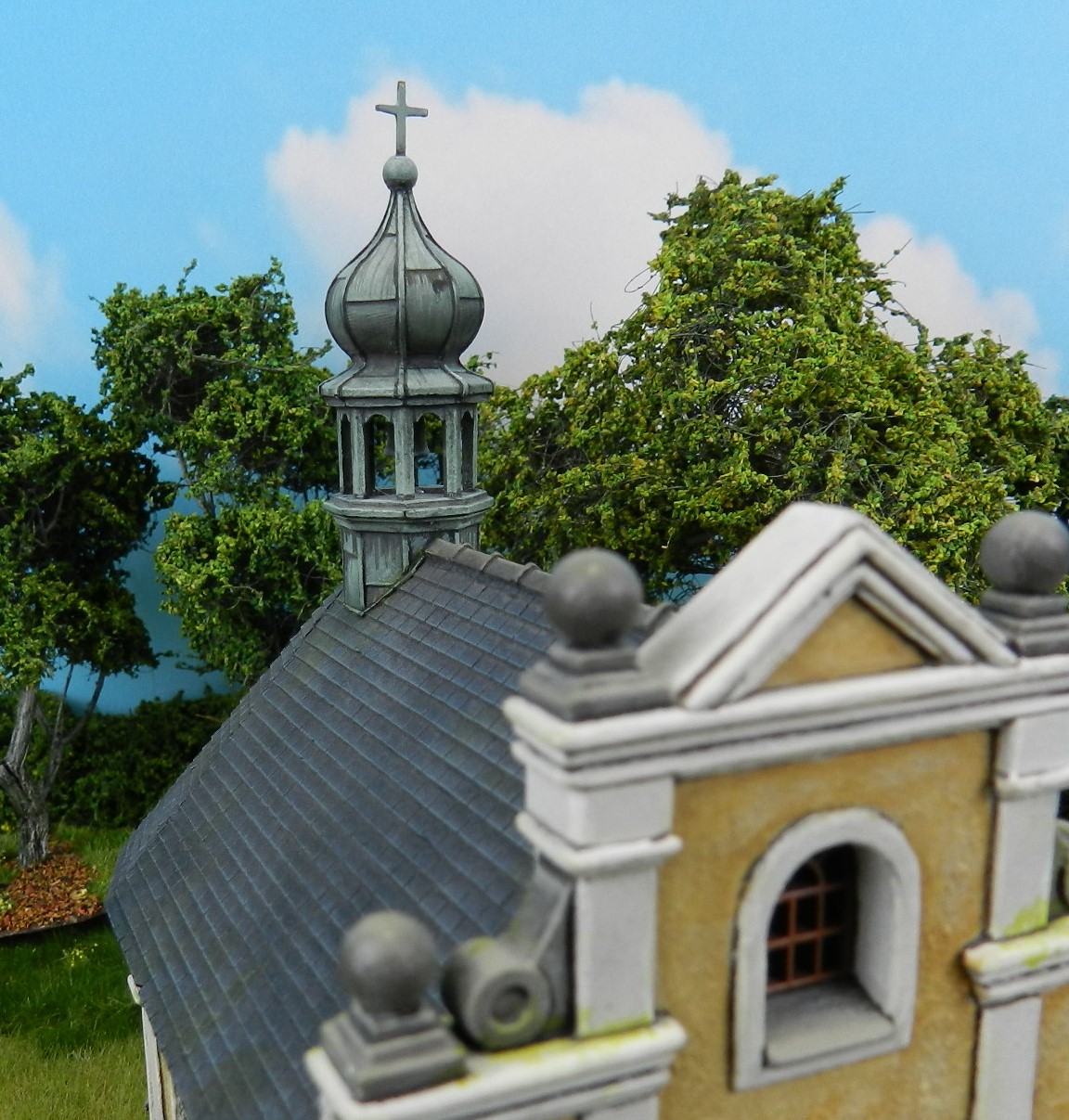
This is the version of baroque style which prevailed across central and eastern Europe from the seventeenth century to the present, in the form of churches, official buildings and larger dwellings. 

The curly ornaments are from the jewelry department of Hobbycraft. The balls are mapping pins from the same source.

A "thing" with the Bohemian version of baroque is to have curved walls. Some churches and chateaus even have the side walls curved out, which gives me nightmares when I try to work out how to do a slate roof on top of such a thing!

The dome is based on one from a Faller model railway kit, although I added the overlapping sheet effect to the bronze roofing. 

Here Gablenz is joined by hussar colonel Wallis, who commanded one of the light cavalry brigades of the army.


Thursday, 20 October 2022

Some Little Details

After last week's Big Production, here are some nice photos of a more modest project from maybe ten years back. I did it for David Imrie, whose photos these are. The idea was to take some of the Hudson and Allen mediaeval buildings and work them up into three village units by painting, adding scenic bases, trees and little details. I already posted a couple of images of these village units ("A Smaller Project", December 2021, under the France label). I always thought there were some nice little touches that those images didn't show, so was pleased to find some more pictures, lurking in plain sight, on David's Facebook page from right back in 2013. And with his kind permission here they are.

The details on this unit are the row of beehives and the "cock crowing on the dungheap", as the saying goes.

A nice group of storage containers here. 

This one's all about the pigs and their trough. I built the shed, but in self-criticism mode I would say the roof is rather too shallow in pitch. Wooden shingles wouldn't keep the rain out on an almost flat roof. Those pigs wouldn't keep dry, although with such appetising and plentiful swill I expect they will get by.

A line of mediaeval washing is the feature here. 

A cat picks his way along the top of a wood pile in this photo. I'm quite pleased with the natural grouping here. The logs are just bits of twig, though I think I painted them up a little bit.

All three units combined into a village, together with a church I made.  


Saturday, 8 October 2022

French Baroque Chateau

Finished at last! I've been working on this chateau model for some three months now, and here it is. Whether it was worth all that work is up to you to judge, but I honestly don't think I've ever built anything more elaborate as a single model. 

Before you started to read this, you will no doubt have seen the new header picture of my blog. It shows Bavarian staff of the Franco-Prussian War: an officer of light cavalry reports to corps commander, general von der Tann. What's not changed is it still showing a wargames building by me, but figures mostly painted by my friend Garry. I converted the figures from 1866 ones by North Star. We work as a team on most of our wargames projects.

This was the second of three models I planned as a project. The first was the "mini chateau" posted a couple of months back, and the third will be the sort of chateau which started life as a mediaeval castle so is built of stone and has round towers. France is a country with perhaps 20,000 chateaus; no-one really knows the true number. Hundreds of the most attractive can be viewed by region on this nice site: So Châteaux (sochateaux.com) No wargamer is ever going to have more than a couple of such models, so I wanted to build something that would represent the most characteristic types. When you really boil down the enormous variety of styles it comes to those which were once castles and those built from the 17th century onwards as stately homes, mostly in the style we call baroque. That means a version of classical architecture which stresses regularity and avoids over-elaborate details, but overall aims to impress the beholder as a dignified, tasteful display of power. So here's my attempt to express this, whilst keeping to a quite small "footprint" consistent with the ground scale of my games. 

The building is made from Wills sheets for the tiles and brickwork, resin castings for the windows and other details, and a lot of individual stones cut from styrene, as described on the work-in-progress post six weeks ago. In all there are well over a thousand individual parts.

In some ways French baroque is "all about the roofs", so I went to town on getting a complex roof shape. It comprises a central hipped roof section and a separate "mansard" roof at each end. A mansard roof is the typically French style that has a near-vertical outer face, usually of slate and a more horizontal top, normally of sheet metal. 

A common feature is what I call the "tricolour" scheme of contrasting reddish brick walls, off-white stonework and almost-blue (well grey really) slate roofs. I avoided anything which would disrupt that attractive colour scheme, keeping the roof finials grey rather than verdigris green for example. 


At first glance this looks like the previous picture but in fact it shows the back of the chateau, which has a different, plainer doorway.

And here's the side view. There are four different window types.

Elaborate chimneys are a feature of this style of chateau. The architectural detail of each one reflects that of the building as a whole, the materials contrasting nicely with the grey of the roofs. Because nearly all photos are taken from ground level, I couldn't work out where the heck the smoke actually emerges from this kind of chimney, there being no kind of chimney pot! Eventually I found a promotional video of one chateau taken by drone and discovered they have a line of slots along the very top. 

The tops of mansard roofs are made of sheet metal: lead, bronze, or from the nineteenth century zinc, as shown here. I studied pictures of old zinc roofing and found it tends to vary a little in colour between sheets, and to be vertically streaked by rain and dirt.

The front entrance from close up. You just might have wondered who the face is supposed to be on the dormers and above the door. These architectural embellishments might show a coat of arms or a pattern, but a face is another possibility. I took the original from a plastic figure. I see him as either an illustrious ancestor of the owner or perhaps a classical hero with some supposed link to the family.

Another staff group poses in front of the chateau, this time a Bavarian divisional commander. He's a conversion from the the Perrys' figure of Prussian general Steinmetz. You do get more idea of the relatively small footprint of the model here. It's actually just 134 x 89mm.