Showing posts with label America. Show all posts

Monday, 27 June 2022

Gangsters' Paradise in the Roaring 20's

2017 was an eventful for me, a good one certainly, but I got out of the way of wargaming and modelmaking for a time. Seeking to get back into it with something fun, I had a go at skirmish gaming the Prohibition era in 1920's America. 

Constitutionally prohibiting the sale of alcohol from 1920 onwards achieved little other than a massive increase in disorder and corruption, whereby the intoxicants were supplied by ultra-violent criminals, and in more dangerous circumstances and quality. So just like the "war on drugs" of the last 50 years in many ways. However, in 1933 fact-based reasoning was more widely persuasive in the American political system than nowadays, so prohibition was ended in 1933 to near-universal relief. 

But anyway, it's a fascinating period to game and we are well-served with figures, terrain and rules. I always liked Mark Copplestone's gangster sculpts, and the Pulp Figures range mixes in nicely. Great Escape games offer some buildings that are as nice as laser-cut MDF can be, even if relatively pricey. For rules, look no further than Howard Whitehouse's Mad Dogs with Guns, which are fun, workable and packed with atmospheric anecdotes. For a time I researched the period, learned all about the history, the buildings, the fashions, the vehicles and the characters, but the butterfly thing got me and I moved back to proper wargames periods, like the Franco-Prussian War.

So here we are, livin in gangsta's paradise, so to speak, and something bad is about to go down outside the tyre store, a Great Escape Games building, although repainted and dolled up somewhat by me. Copplestone figures. The die-cast car is by Solido or someone. I got a few vehicles but didn't get as far as improving them significantly.

I made the tarmac road system myself, something we'll  come back to another time.

Here are some honest-looking US citizens exercising their constitutional right to bear arms. No doubt they will only be used against King George or any other tyrants seeking to repress their freedoms! This building is one I scratch-built, although using some bits from ancient US model railway kits. The brick walling is from the Wills sheets.

There's definitely a story in this vignette. "Bad day at the office; I couldn't even get the dough out of Mrs O'Hanrahan, and then a cop showed up!" At any rate, here's the other side of the above structure. The movie poster dates it firmly to 1927, so right in the middle of our period. 

I did make a second building, better and bigger, but didn't quite finish painting it when the realisation dawned on me that I could make a dozen such structures and I still wouldn't exactly have Chicago, so I had to look for a more realistic approach. What I found was the Mean Streets range by The Virtual Armchair General. You buy PDF's online, which you print off on thin card, or else on paper and stick them to foamcard, as I did. The result is slightly brash but tolerable blocks of American city buildings for the era, each about 10-12 inches square. With these you can build up a useable cityscape, which I duly did. I haven't photographed them, as they are someone else's work really, but you can see them on TVAG's website Mean Streets Main Page (thevirtualarmchairgeneral.com). They also do an interesting set of rules "We Only Kill Each Other", for anyone sufficiently interested to try something more detailed and somewhat RPG-like.


Tuesday, 30 November 2021

The last of the AWI buildings

 Here's the last two of the series of AWI buildings I made for John Ray. There's not much to add in terms of how these were constructed, but a couple of details might be worth mentioning. 

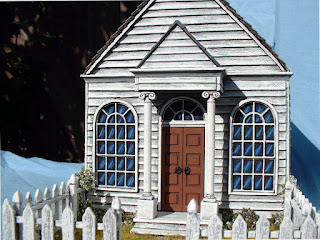
The church windows owed something to the "industrial windows" from the Wills range. The dome was made by overlaying the cast tiled dome of the same shape with styrene sheet, then adding joins/ribs to represent a lead sheet covering. I had struggled earlier to find a way to add a cross on top of a dome or spire that wouldn't be vulnerable to the first knock. The solution shown here relies on a teeny bit of metalwork. You start with a long rectangle of brass sheet, about 1mm thick. Put it in a vice then cut the four corners out with a fretsaw (aka coping saw), finally tidying up with a square-section file. Sharpen the bottom arm and superglue into a drilled hole, and you have something suitably sturdy.

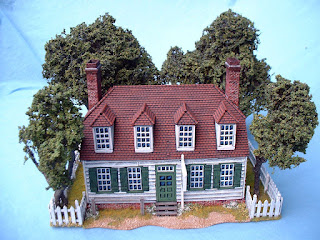
The brick house involved a lot of Wills brick sheets, predictably enough. The "wrought iron" gate was made from cutting out segments of 1/12 scale dolls house ironwork. It's in a tough plastic, ABS or something, so sturdy enough for gaming use.


Saturday, 27 November 2021

AWI Tavern

Once again an AWI building based on a real example, today's model being a tavern with a little smoke-house in the back yard. Both buildings are freestanding from the base so can be used in different ways.

This was made in the same ways as before, though obviously it is a little bit larger and more involved than the houses you've seen over the last couple of days. The roof was done with the Wills plain clay tile sheets. The dormer windows are all castings from a master model I built. The fence is hand-made, which must have taken me a while. I also hand-painted the sign "The Swan", based on researching 18th Century pub emblems. I was concerned to protect the hitching rail and sign at the front from accidental damage, so they are set well in from the edge of the base and heavily reinforced with brass rod.


Friday, 26 November 2021

AWI Burcher House

 Another American Revolution-era house today, this time the all-wooden "Burcher" house. To this day I don't know whether that name indicates the style, or if the original was owned by someone called Burcher. You will see that there are actually three model houses of the same design but with green, pale blue and grey details respectively. The first was made for John Ray, but two other customers wanted the same thing for their games. 

Wood for the shingles and the clapboard was made from thin balsa sheet textured by brushing along the grain with a brass-wire suede brush. This strips off the softer grains, leaving a more deeply textured surface to be dry-brushed. You texture quite a big sheet ready to cut into strips. Don't try to texture both sides, as the flimsy material will fall apart. I find it's useful to scribble over the untextured side with a bright marker pen, so that when you end up with hundreds of little rectangles for shingles you can tell the textured side from the plain one at a glance.

There's a tool called a balsa stripper specifically for cutting identical strips quickly, although I find it fiddly to use, so you may be just as happy with a steel rule and scalpel. For shingles you cut strips first and then cut those into individual rectangles. I use a great tool called a "chopper", a kind of tiny guillotine, the original one being by a model railway firm, North West Short Line. The shingles are glued on a row at a time: apply a line of PVA or wood glue, then pick each shingle up with the point of your scalpel to position it. The trick to getting a realistic appearance with this is to apply the shingles slightly irregularly. Don't overdo this, as is commonly done with fantasy buildings. I think that looks a mess, and it wouldn't keep the rain out! 


Thursday, 25 November 2021

American War of Independence (AWI) Stone House

Over the years 2001-2 I made a series of models for wargamer John Ray, all to go with his games of the American War of Independence. The original here was built of stone with a roof of wooden shingles, which is an unusual combination. Each building model had a little garden or at least a tree, some bushes and what-not to set it off. 

The walls here were made of Wills stone sheets and the chimneys of brick sheets by the same company. The roof was covered in individual shingles of textured balsa sheet. The windows were metal castings, which I think John provided. Normally I would make windows with a transparency and something dark behind, but John asked for this blue "sky reflection" look. The doors were my castings which I had ready from the Wild West town project.


Friday, 12 November 2021

Some early commissions

 The year 1990 found me found me strapped for cash despite holding down a full-time job, so for a while I used what I'd learnt so far about making wargames buildings to eke things out. I made models for several well-known wargamers at that time, and found out that some people could be very fickle about what they wanted, yet quite assertive about how much they wanted to pay. And everything took me much longer than I had expected, because I wanted to finish it to my own standard regardless of payment. 

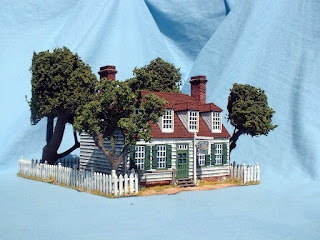
One customer who didn't mess me about was AWI gamer John Ray, and here's some photos he took of two models I built for him, based on contemporary line drawings of a house and a church of that time. I think John supplied some castings for the windows, and the figures shown are his own. Otherwise the building methods are what I've described before: card, balsa, Wills plastic sheets and model railway fencing. I wouldn't make the same choices now with all the methods and colours you see here, but there's no learning without trial and error.

The tree and hedge foliage is rubberised horsehair, teased apart and sprayed black, with leaves added from dyed cork granules. Don't worry if that sounds a bit obscure! I have been improving this technique over many years and I will explain it properly in future posts, hopefully a tutorial as such. I recently built new trees for my own table in two batches. I was a bit fed up of trees in the end to be honest, but I've got 50-odd nice ones made, reasonably quickly and cheaply too.


Friday, 5 November 2021

The Wild West

I made these two shops as prototypes for a Wild West Town planned by Foundry in the year 2000. The plan came to nothing as with so many plans of that period, but here they are anyway. I posed them for the photographs with some of the simple-but-evocative figures sculpted by Mark Copplestone. These images want to tell a story of frontier life, but sadly the blue sheet background is a bit too hard to ignore!

The models were made primarily out of balsa wood, although again I built and cast a little range of windows, doors and so forth. The "tarpaper" roof was just made from masking tape. Balsa makes a great representation of grained wood in miniature. What you do is to brush quite hard along the gran with a suede brush. This strips out the softest fibres, leaving you with an enhanced grain. Once this has a solid black undercoat on, it responds very attractively to successively lighter drybrushes.