Showing posts with label Spain. Show all posts

Wednesday, 7 August 2024

We're Back!

I know, it's been six months. And blogs are dying like flies. So you would be forgiven for thinking Hand Built History had gone the way of all flesh. But nope, the show is back on the road, with enough material for about three more posts after this one.

So what has kept me from feeding the blog so long? Loads of things and nothing much. Heath issues (nothing terrible, touch wood). Been working hard on my Franco-Prussian rules. Don't enjoy the process of photographing my stuff as much as some folks do? Slothfulness mostly. Thanks anyway to those of you who have been in touch during this downtime. But HBH is back in the groove now. So without further ado:

An Unexpected Turnup

Some of you might remember me musing wistfully, a couple of years ago, about the "projects that got away", the models I had made for customers and got no photographs of. I meant three particular sets of things back then: a German village done as a commission for Jonathon Marcus, a layout of Basque/ Northern Spanish buildings and a group of  ancient Trojan buildings. Both the latter being done for (or with) my late friend Mark Sturmey. 

Jonathon Marcus got in touch with some great pictures of the German village, which you can see if you click on that "label" in the right-hand sidebar. Then some photos (of mixed quality) emerged of the Basque setup, from a demo game which Mark did at the Reading show. But neither hide nor hair of the Trojan stuff. 

However recently I was alerted by my friend Martin Gane that wargames buldings looking a lot like mine were for sale through Hinds Figures, who trade in second-hand wargames figures mostly, but also some books and terrain items. It did turn out that Mark's collection had been moved on in this way. His numerous wargames armies had been bought, mostly by a well-known UK gamer, but the vanished buildings were being sold (at insultingly cheap prices, ahem!) by Hinds via their Ebay page. Evidently the Spanish buildings had been split into four lots and the Trojan stuff into two. Someone had already snapped up one Trojan lot plus the very detailed Basque church. Martin himself picked up two more lots of Spanish buildings. And I took the plunge and re-acquired the remaining one lot each of Spanish and Trojan things.

It was a pleasant if slightly strange feeling to unpack these models which I had built but not seen for about twelve years, and not had decent photos of either to remember them by. We will be coming on to the Trojan things in the next post, but we'll start with:

Basque Buildings

In my humble opinion someone got themselves a heck of a bargain with the Ebayed Basque Jesuit church, judging by the prices being asked for the other lots, but good luck to whoever it was. There's one or two pictures of that model if you click on the "Spain" label.But the rest of this project is now either back with me or with Martin, who was kind enough to take some nice pictures and send them over. 


Village dwellings in the distinctive, rather dour, style of northern Spain. The whole setup was partly made by me and partly by Mark and myself jointly. The two structures here were originally constructed as a single L-shaped building as part of a town. On re-acquiring this I decided it wouldn't really fit with my notoriously small village layouts, so I cut it apart and re-worked things a tiny bit to create two smaller houses.


Thes models were mostly built from the Wills sheets as I've often described, with a few of my cast doors and windows. The walls use the "Random Stone" sheet, which makes a change form the standard stonework sheet. If I'm to be picky, the chap who originally sculpted this sheet was a bit careless of how stone walls are "coursed" by the mason, but it all drybrushes up very satisfyingly.


These three buildings can now go in the big box with my other Spanish stuff. One day I'll get to play with them.


This building is what's called a horreo. To be seen across most of Spain, they are storehouses for grain and other produce. The stone "mushroom" legs are to make it hard for rats and other critters to get in. I made this little model as a present for Mark.


The last three photos are by Martin Gane Here we have a town block, which Mark and I put together very much as a joint effort. Good memories. We aimed to show the three building styles common in this part of Spain: stonework, timber framing with brick infill, and rendered stone with some faint pretension to a neo-classical style.


The back of the same block. There was also an old tower and other small items in the town display, which you can see if you click on the sidebar "label". 


Finally a tradional Basque farmhouse, a basseri, which was another one I made for Mark as a present. These farmhouses worked on the principle of "a whole farm in a single building", common across much of Europe but totally contrary to what we expect in Britain or the US say. In this case, the little door you see in the centre was for animal access to a byre or stable. The living quarters are upstairs, with a balcony to take the sun. The covered place at the front was a covered outside work area, where you could sit to mend things or do rustic crafts. Tools were hung around this area and you should be able to see at least a sickle and a tiny saw which I made to go here.

Monday, 1 August 2022

A Basque Town and Farm

A couple of weeks back I showed a not-very-good picture I had stumbled across of buildings from the Basque provinces of Spain. Those models were amongst the "ones that got way" as I lamented back in December, ie the models I'd made but hadn't photographed and no longer had access to. Since then I had kindly been sent some lovely photographs of the nice German village done for Jonathon Marcus. And now I have some decent pictures of the Basque models, so the only thing still missing from the record at this stage is the Trojan setup once made for Mark Sturmey.

The new photographs came initially from my friend Simon Chick, who had photographed them during a demo game at Salute 2014. But knowing now what show it was, I was able to search for other photos of the game. And I found them on two different blogs, called History in 1/72nd and The Lost and the Damned. (I tried to contact the owners of both blogs to check they didn't mind me reposting their pictures, but got no response in either case, from which I conclude there's no reason anyone would be bothered. Of course if I hear differently I will act as appropriate).  Right, here we go.

My late friend Mark had eclectic interests in terms of wargames periods, one of them being the Carlist War of the 1830's, largely fought in the Basque provinces of Spain. Mark used to pay people to paint his figures, but was keen on building scenery, a skill he was learning quickly before Motor Neurone Disease sadly halted him. This town was therefore perhaps half my work and the rest by Mark or made and painted between us. A couple of rendered buildings to fill out the town were taken from my earlier generic Spanish buildings.

The centrepiece church was one element that Mark paid me to make on a commission basis. It is modelled on a Jesuit church of around 1700 which stands in one fought-over Basque town. As you can see it has the unusual combination of a rendered structure with an elaborate but slightly grim stone façade.
In the north of Spain the typical rendered buildings largely give way to bare stone or half-timbered ones, sometimes infilled with brick. The roofs are still low-pitched pantiles in the Mediterranean style however. You can see all these elements in the model.

I built this cross to go with appropriate figures that Mark had sought out. Such vignettes add to a battle painting or a demo game. 

And here's another one, based on a typical local pattern of well.

As a present I made Mark this Basque farmhouse or baserri. It has the typical recessed portal, creating a work area useable on rainy days. Sadly you can't see them in the photo, but there are little scratch-built tools hanging up within!

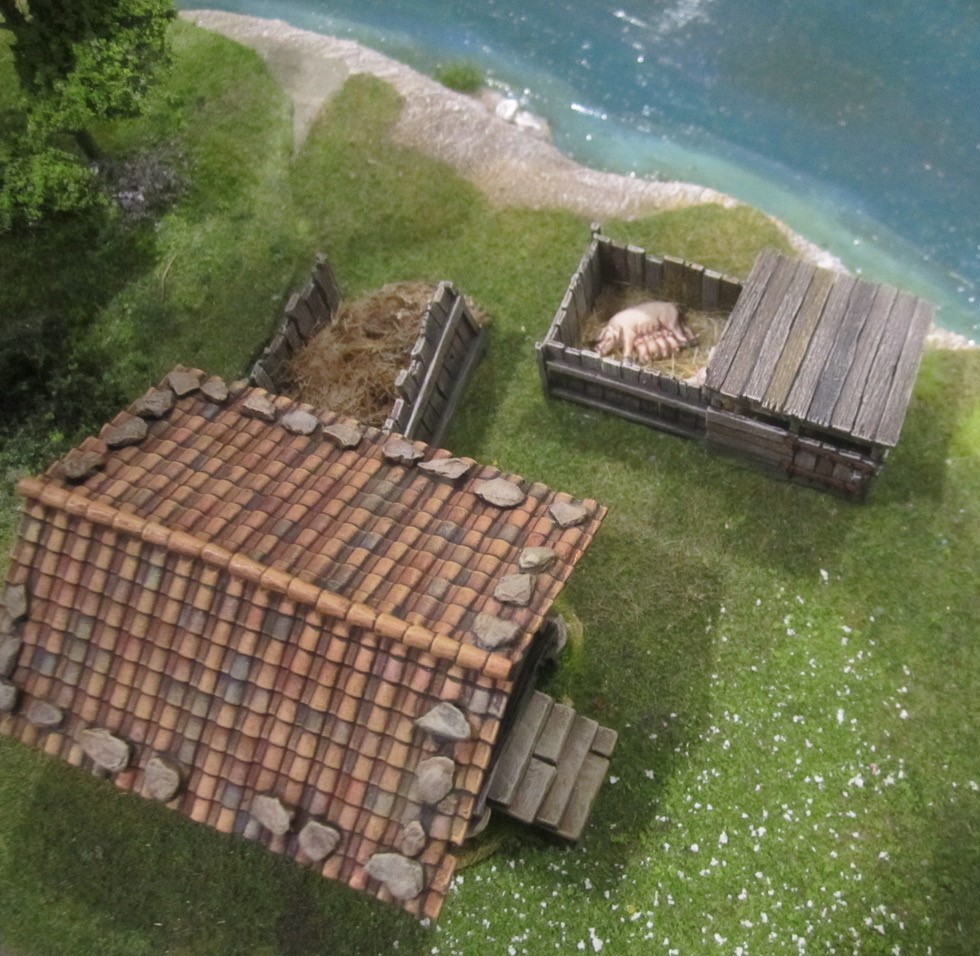
Another present was this granary building in the local style, standing on stone "mushroom" legs to protect the contents from damp and vermin. A pigsty and muck-heap complete the farm.


Wednesday, 13 July 2022

A Little Find

I was planning to post about the roads project I worked on last year, but I am afraid my internet access has been playing up. If I mention the term "DNS server", some of you will know what level of trouble I have been contending with. If you have no idea what "DNS server" means, count yourself amongst those upon whom the gods have smiled. 

Anyway, whilst waiting for months to speak to some godforsaken customer service department, I was idly scrolling through images in my terrain reference folders, specifically the one with pictures of Spanish buildings, which I'd had no cause to look at for a long while. To my surprise I stumbled across the image below. What it shows is a demo game from a show at Reading(?) in about 2013. The game was mounted by my late good friend Mark Sturmey and was based on the First Carlist War in Spain, featuring a collection of buildings, images of which I lamented back in December as being lost for good. So this was a nice little find. I don't know who the photograph was taken by, and I'm afraid it's not entirely in good focus, but it gives some idea of what these buildings were like, in particular the elaborate church. I made that myself, but the other buildings were a joint production between me and Mark, who passed away five years ago now after bravely fighting Motor Neurone Disease. Mark was learning to build and paint terrain very skilfully before the cruel condition took away that possibility. 

These are all based on the building style typical of the Basque region, the heart of the Carlist insurrection. Most houses were built of bare stone, but some were rendered and others of timber-framed construction. The church is based on one still standing in a town there. Unusually it has a plain back, but then a quite elaborate baroque façade and porch added in the late 17th century. I laboured long over this, using Wills stone sheets and several parts which I moulded and cast. There are also several "bits and bobs" from own Bohemia setup, which you will be seeing properly in due course: a statue, a covered well and wayside shrine.


Monday, 15 November 2021

Spanish Village Units

 12 days of Hand-Built History and a post every day! This will slow down once I have posted images of all the projects I've got photographs of. But that will keep me going another week or ten days yet. 

Today's effort is the Spanish village units I constructed in 1999, to go with Garry Broom's vast Peninsula War collection. You cans see them posed in most of these images. Although making models flat out during the term at Hertford Uni, I was one of the few who still wanted to be building stuff during the holidays. James Sharpe was another, as I recall. 

This might be the point to explain what I mean by "village units". As I was a wargamer who plays games with large, strictly applied  ground and figure scales, I had developed the technique of starting with a base which covers the real ground area of a village for the period, to the ground scale in use. That's quite a small area when 1" = 100 paces say. Each base is then given a "perimeter" of walls, hedges or fences as appropriate and incorporating a few trees as well. Finally each one gets several buildings, perhaps including a church. Thus in a very finite area you have the impression of a real village rather than one large house its own, which sometimes stands for a village on the wargames table. The pictures you see here actually have a couple of such units pushed together for photographic purposes, but hopefully you get the idea. You should be able to pick out the same arrangements in other village units build for home use, such as the recent Ardennes stuff. 

Another feature of what I build for my own use is that the buildings are somewhat "condensed" in their ground area, whilst still hopefully looking credible with the figures used. This is so that several of them can be fitted into a village unit and give an attractive impression of a village. They are kind of not meant to be looked at as an individual house or church, but seen as part of a larger entity. Some wargamers don't like this approach, but each to their own. Of course when I built models on commission it was up to the customer. 

The other exception I make to this approach is when building something for a skirmish-level game. In this case each window or door can matter, and a structure has to look real-size in its dimensions. When I get them photographed, you will be seeing what I mean with some WWII "Chain of Command" buildings and a few Chicago gangster things I made.