Showing posts with label Work In Progress. Show all posts

Sunday, 4 June 2023

More Work In Progress For The Battlefields Of Lorraine


More Lorraine WIP

It's been a while since I've posted on the blog, but here's what I've been working on: more buildings for the French province of Lorraine, where the decisive battles of the Franco-Prussian War (FPW) were fought out. Two churches a tavern and a kit-bashed factory, plus some "bits" to fill up the eventual village units.Time to get the paintbrushes out now. Comments on the individual images below. 

Partizan 2023

A few weeks back I enjoyed a day at the Partizan show with my friend Garry Broom. Bought a few things, not least a box of the new Perrys' plastic FPW French. I was touched to get a mention on the information sheet of the set "for additional flag information". Like their Prussian counterparts this is a great set, well proportioned and animated, with lots of choice and a good level of atmosphere and accuracy. I do worry what's happening to the range as a whole though, as it's a full year now since any metal packs were released. 

Talking of Perrys, we bumped into Alan P, who showed us images of the Napoleonic Ottoman cavalry he has sculpted but not released yet: mamelukes, dellis and other exotic types are all ready. It was also great to catch up with pals such as Dave Marshal and James Sharpe (both fellow wargames modelmakers), plus David Imrie, Phil Olley and a real blast from the past, Mark Copplestone, who was demo-ing his 1930's Little Soldiers. Mark is a bit of a leftie like me, and we had a great discussion about the part played by Frederick Engels fighting the Prussian army in the Baden revolutionary war of 1849! Obscure stuff alright.

I'm afraid I sometimes don't look very hard at demo games focussing on the American Civil War, which doesn't interest me much, but Dave Imrie drew me to a model within the game he and Dave Andrews were putting on: a beautifully detailed little lumber mill. We don't see as much from Dave A as we used to, which is a great shame because he has always been one of the very top wargames modellers. This sawmill was a delight, obviously based on study of a real example. It would be ideal for a Wild West game. I would really recommend you look out for this model in photos of the show.

The church of St Privat, a last stand in the churchyard of which forms the subject of about the best-known painting of the FPW, by Alphonse de Neuville. In a slightly "condensed" form this is what it looked like. It was burnt out during the battle and replaced by a new church elsewhere in the village, but the iconic churchyard gate still survives.

This church is based on the one in a Lorraine village called Bremenil. I used a Redutex textured sheet for the dome and it seems to have worked well, easily fitting the curve of the dome here.

When I studied modelmaking long ago we were encouraged to make a "sketch model" to work out the shape of the planned structure. It's not often I bother, but it seemed a good idea in this case, and helped me dodge one or two potential pitfalls. As you can see, it's just cheap card stuck together with masking tape. I kept it just to photograph and now it can go in the bin!

The scene of another favourite painting by de Neuville was the "Auberge du Croix de Lorraine", which you see here. You know, it's the one where a captured French agent stands defiantly before the Prussian staff  lounging around a cafe table! I've never worked out whether this was a real establishment or just an artistic excuse for the dramatic metaphor the painting comprises. At any rate there don't seem to exist any other images of the place whatsoever, so I had to guess everything that isn't in the painting.

Some Lorraine battlefields included early industrial buildings. I bodged this together from an old HO kit by a firm called POLA, "The Old Brickworks". I'd had the kit for 40 years, but it's still available online. Should paint up nicely and contrast with the more traditional buildings.

Finally some "bits": the cross and the pump of Rezonville and another village pump based on contempory illustrations. The first two feature strongly in the Panorama de Rezonville, painted by de Neuville and Edouard Detaille. These models were scratch-built out of styrene, brass rod and a bit of balsa. Pumps seem to have replaced village wells in the late nineteenth century.


Friday, 14 April 2023

Lorraine Houses Work in Progress

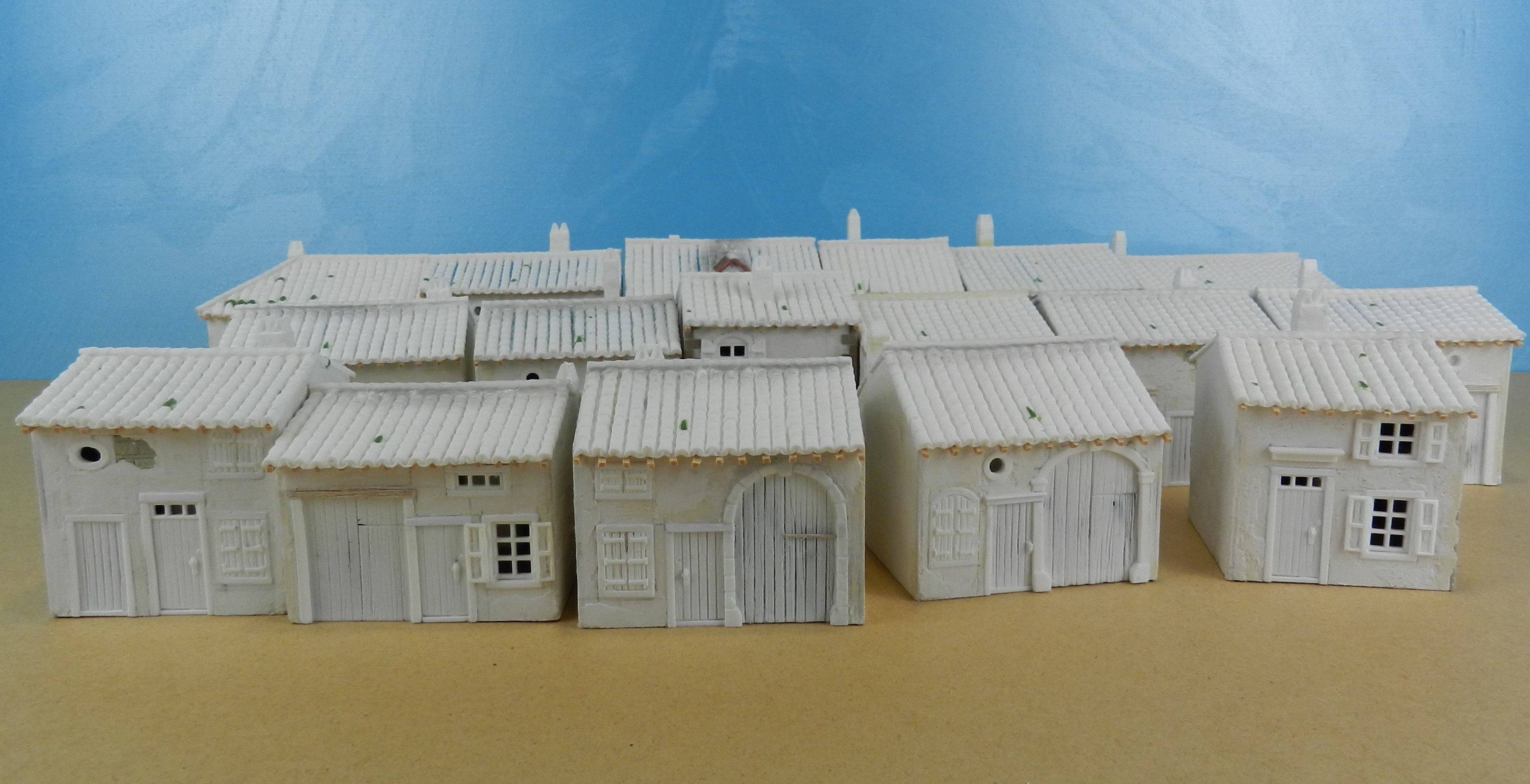
Hello everyone, here's another post, if not quite what I had planned. The intention was to arrange the pine trees, fir trees, coniferous wood bases and some Austro Prussian figures into nice scenes, just as folks out there in wargames-land seem to like best. But I've been very solidly locked into my project to populate the 1870 battlefield with villages, over the last couple of months now, and that's starting to bear fruit. So here's what I've been up to. There are seventeen houses for the Lorraine region built, leaving maybe four buildings to go before the paintbrushes come out: two churches, and inn and something industrial. After that there'll be some sort of village bases, a couple of detail items and perhaps some railway line. And then I'll be ready to refight a lot of the Franco-Prussian battles, from Spicheren to Rezonville.

Probably I've made this point before, but the FPW was fought over the whole of Northern France and each of the provinces had its distinctive local style of architecture. I did do some for the French Ardennes region twenty years back, but they are a bit drab and I felt I could make something better now, so had to decide between the vernaculars of the half a dozen regions remaining. There is no "generic French" look, as wargamers like to think, or certainly not before the twentieth century. This was my thinking, after discussions with gaming friends:

  • Alsace? Lovely half-timbered buildings, would serve for Germany, but b*****s to build and only two FPW battles happened there. And we've already refought one of them (Wissembourg). 
  • The Somme/ Northern Front? Tempting, because we've been playing out the adventures of the Armee du Nord, but there weren't many battles and the armies were very unevenly matched.  It was all snowy when the battles happened, and I'm not ready to build winter woods and all the rest of it.
  • North of Orleans? Same issues really, even though more battles happened there.
  • Around Paris? Same issues again.
  • Franche Comte/ Belfort? Same again, but even more so.
  • Lorraine? The most dramatic, decisive battles were fought here, with the armies "fairly" balanced. The style is a little plain, but I was inspired by the paintings of Alphonse de Neuville, and especially the Panorama of Rezonville. And I thought the rendered, pantiled houses would do at a pinch for something in Spain or Italy some day. So that was the decision.
As you will know if you have read earlier posts, my quirky approach to wargaming is that I want to do quite big battles, on a normal sized table (6' x 10' max) and with 28mm figures. So this means a very small groundscale, an inch to 100 metres in the FPW case, hence a village is only maybe 100mm square. So we can only aim to have a couple of small buildings a tree or two, a well or something and a little bit of garden wall. Now that can evoke a village very pleasingly if done right, and you can have a dozen of them on the tabletop. But the upshot is each building has to be distinctly "condensed", as I've discussed before. Some wargamers don't "get" this approach, but it would be a dull world if we all thought the same, as they say. 

Anyway, small buildings, but lots of them, historically accurate, detailed and individually varied works for me. I researched the Lorraine style quite thoroughly, then made plans, built master models for individual components, moulded them and cast what I would need. Then I set about putting things together, working to ensure each house was different to the next.

Here's the whole lot together. You're seeing the fronts of buildings, with the characteristic barn doors. The shape of each model is made from mounting card, cut out for the doors and windows, and roofed with a cast sheet of the correct "canal" pantiles. (Or you could use the Wills or Redutex pantile sheets). The dark spots you see are little alterations or corrections done with green stuff.

A real Lorraine village consisted of the houses built in a row either side of the street. The area in front of each house comprised its farm yard, with piles of wood, muck heaps and whatnot, but we won't be able to show that in practice.

The backs of the houses were quite plain. In reality there were bread ovens, pigsties and outhouses there, but I can't spare the ground area to show that. 

Typical facades. One side of the house is for living in and the other is agricultural. I made three types of door, three barn doors, three chimneys, windows with shutters open and closed, and with flat and rounded tops. A quirky local feature is the vertical posts of doors and windows being combined into one stonework column. And another is the round or oval "portholes" which ventilate a hay loft.

Houses at the end of a row could have hipped roofs as here, or semi hipped. In this situation there could be doors and windows on the end wall, which you otherwise don't have. Being one of the slightly larger houses, this one has a third, middle, door on the front, which would open onto a corridor leading to a stable or cowshed behind the barn area. 

Dormer windows were rare in this region of France, but seen occasionally. The pencil arrow on the barn door was a reminder to myself to fix a hole that appeared in the casting. 


Squeezed between the larger farmhouses were dwellings with no provision for farming. This one is "up-market", with dressed quoins (corner stones), nicer details and an alcove above the door containing a statuette of the virgin Mary. Lorraine was as devoutly catholic as most of rural France. The Duchy suffered terribly in the Thirty Years War, and if you know the series of engravings "The Miseries of War" by Jacques Callot, it is actually Lorraine he depicts, and you will recognise the same style of building as in 1870. 


Wednesday, 31 August 2022

Work In Progress: Baroque Chateau


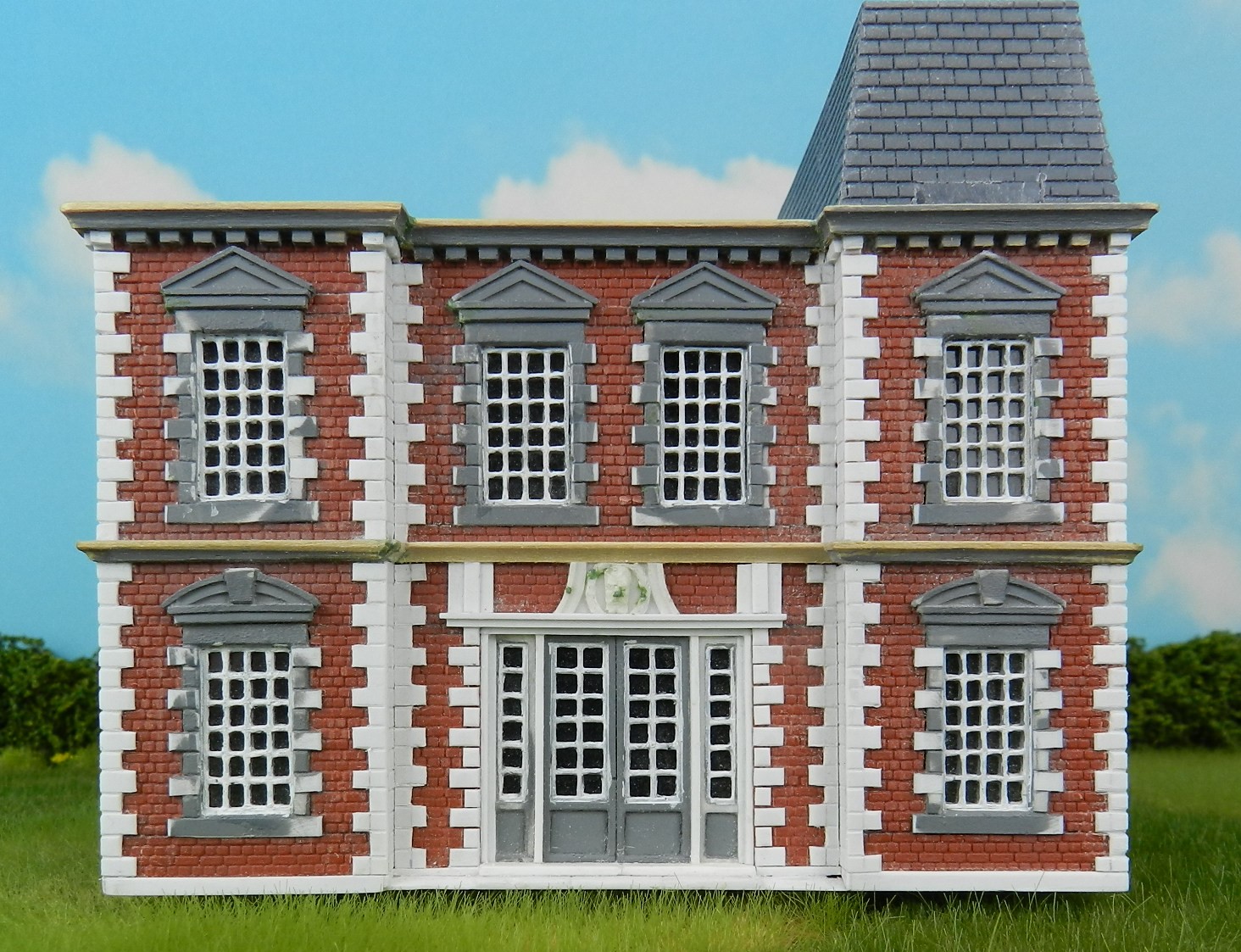
I haven't posted anything for a few weeks because I've been concentrating on building my second French chateau, the Baroque one. I've still got some unphotographed models to do blog posts on, but I thought I'd post some pictures of where I'm up to with this quite elaborate model. There's no intention of showing a particular stage or anything, it's just the point I happen to have reached. 

When I can post images of the completed model, I will give my customary ramblings about the Baroque look and the typical styles of French chateaus. For now I'll just say a little about how this is being made. The basis of the brick- and tile-work is the good old Wills sheets. There are a lot of cast bits where I modelled a master and made silicone moulds, and a (hell of a) lot of parts cut and shaped from styrene sheet and strip. The fourth significant material is wooden mouldings that are sold for dolls house work. The walls, windows and doors of the model are complete and I have started on the roof now. You can see the cast parts for dormer windows and chimneys, to be incorporated in the three-part roof, one bit of which is started. There are over 600 styrene parts making up just the quoins (corner stones), and I reckon there must easily be over a thousand parts in the whole structure. 
 
Hopefully construction on this will be finished in about a week's time, then it will take a couple of weeks more to paint. With a bit of luck it should repay the work that's gone into this model.