Showing posts with label Japan. Show all posts

Tuesday, 9 November 2021

The rest of the Japanese models

 Today's post comprises images of my remaining Japanese model buildings, built in about 1986. By the way, if anyone's not realised it, nearly all the images on this blog will blow up into much bigger, clearer ones if you click on them.

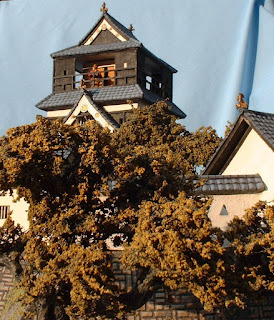
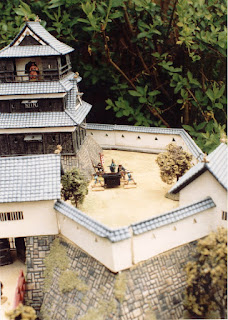
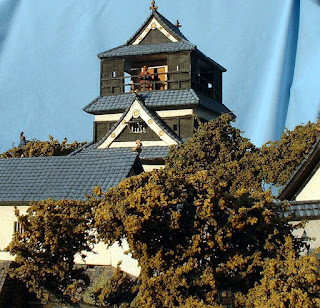
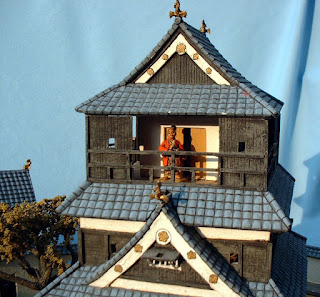
Firstly there's a wooden keep with a stone mound and stairway, very much inspired by the Kurosawa film "Ran". As with the original Japanese castle, it all comes apart floor by floor for gaming purposes, and there are one or two alternative ways the model can be assembled. Once again the figures are mainly sculpted by me, although I used heads from commercially available figures of the time. As you can see the flowing design of traditional Japanese clothing came out alright in some places, but defeated me in others!

The Linka cast stonework had been abandoned by this time and I made the stonework of the mound just by gluing on pieces of carboard and texturing them a bit with household filler. The result was totally robust, and I would never go back! The castle building is all from balsa, but I used plastic model railway fencing to surround the observation platform. Again this "drove out" the fragility problems.


Finally, here's a couple of pictures of a Samurai town mansion which I built. They only show the courtyard really. Some day I must take some proper photos of the detailed interior, which even has real sliding doors.


Monday, 8 November 2021

Mediaeval Japan

 Here are some more photos of the buildings I made in my "turning Japanese" phase of the mid-1980's. These images are of a multi-storey temple, walls and village houses, arranged into scenes and posed with figures from various sources including home sculpted. The photos were taken somewhat later, when I had acquired a trusty piece of "foreground" in the shape of a slab of mounting card textured with earth and grass. The blue background works better when the "join" is well concealed, although the final shot disconcertingly portrays the back garden of my old house!

I am working through the image mountain in something like chronological order. Naturally the later models are noticeably better than these early ones, but I will try to explain the progression of my methods, and mistakes that I learned to avoid, which I hope will be of interest to those wanting to build their own models. 

With these examples, the Linka cast plaster sheets of stone and tile were being replaced by the much better Wills plastic sheets. The thatched roofs were made in the way pioneered by Ian Weekley, based on plumber's lagging felt glued down strongly to card. That is then soaked in thinned household filler and firmly brushed/ combed down. The resultant shaggy mess is then trimmed neatly with scissors and scalpel. Nowadays everyone uses this method with "teddy bear fur" instead of the felt, but the old material worked OK for thick, rough thatch. I seem to remember I painted these roofs with very thin washes of brown and black oil paint. It took ages to dry and smelt like hell, but the effect looks real enough. Actual thatched roofs aren't yellowish at all but grey-brown when new and dark grey for the older ones. 

One big mistake in the building of the temple was how I constructed the platform "fences". I used balsa. fixed together with UHU glue. Now I still use UHU a lot and it's great for sticking card and all sorts of materials, but balsa isn't one of them! I only have to take this temple out of its box and there are breakages every time. The fences are horribly fragile. Wood glue would have worked better, and pins could have reinforced the arrangement, but balsa also isn't robust enough for this kind of structure. I did make a rather picturesque Japanese bridge by this method a few years later, but the same problem defeated me in the end: it was coming apart so fast it never got completed! Later models would avoid this mistake, but that's for the next post.


Saturday, 6 November 2021

My Earliest Model

All wargamers have a "lead mountain", some call it the "pile of shame", comprising all the stuff we bought but haven't yet got around to making presentable. I've got boxfuls of unpainted figures as much as any of you, but I feel I've also got a "photo mountain" that I need to transform into blog posts. So I will crack on, in this case with the earliest of my models which I have images of: the samurai castle.

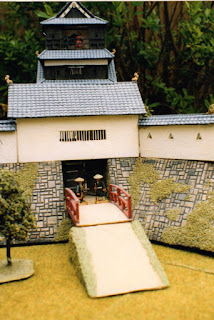
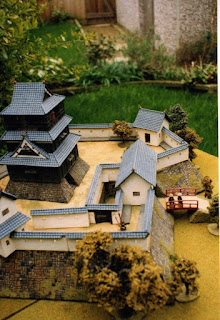
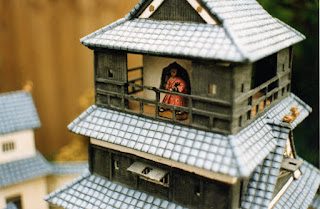
In 1983 feudal Japan was about my biggest wargame interest, largely inspired by the Kurosawa film "Kagemusha". I had to have a castle on a stone-clad-mound to fight over. How hard could it be to build one? Well it took me a year, on and off. And it's by no means up to my later standards. And I've been trying unsuccessfully to protect the fragile material from damage for almost 40 years now. But it was satisfying to end up with a recognisable model that was functional enough for the sieges and ninja attacks that were played over it. The only way to learn and get better is to have a go, consolidate what comes out well and re-think what's not so successful.

The upper walls and the large mound were made from mounting card, with balsa serving for the wooden parts. But the lower walls and roofs were made out of sheets of plaster, cast in moulds by a firm called Linka. It was fun doing the casting, but the result is terribly vulnerable to knocks and chipping, as you can see in some of these photos.


Update: Going through my old folders I found some more nice photographs of this model. As viewers liked it, I thought I'd add them to this post by way of an update. They are at the bottom if you scroll down. (JB 20th November)