Wednesday, 7 September 2022
Basic Earthworks
Wednesday, 31 August 2022
Work In Progress: Baroque Chateau
Tuesday, 9 August 2022
A Mini Chateau
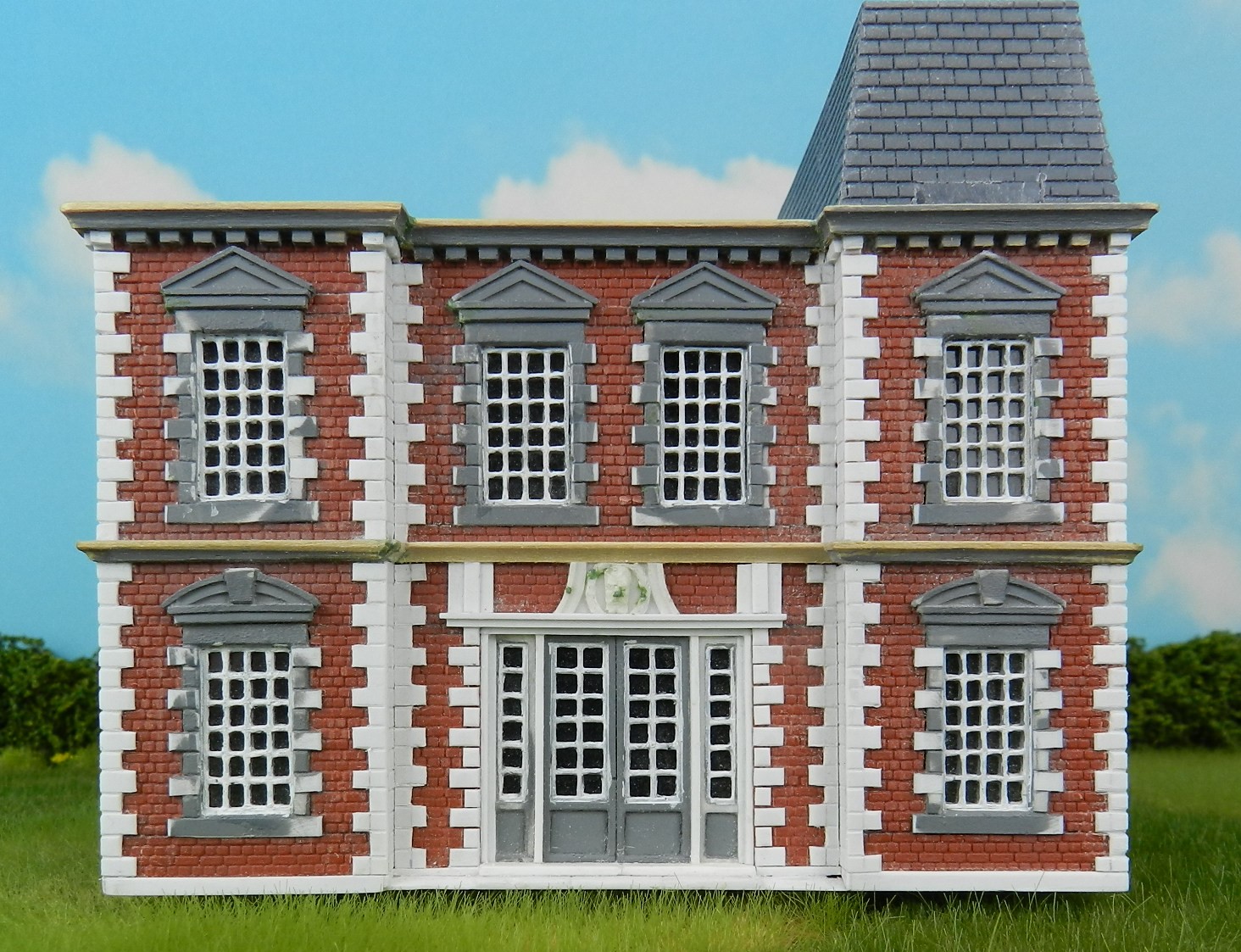
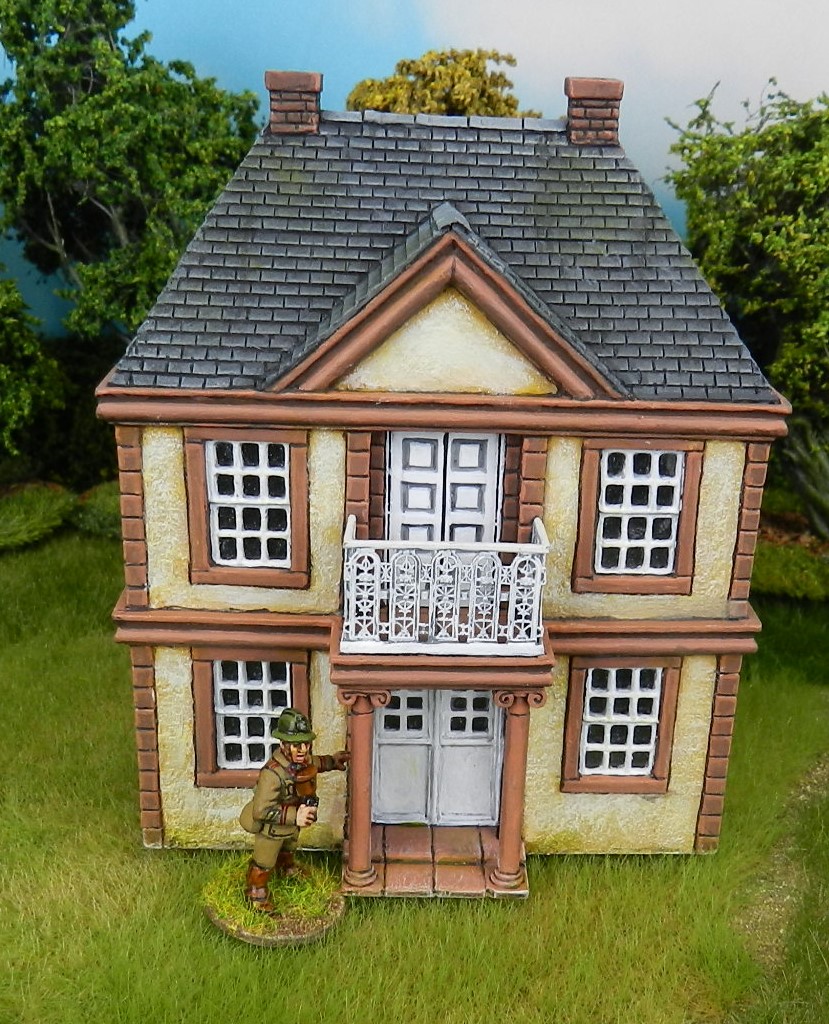
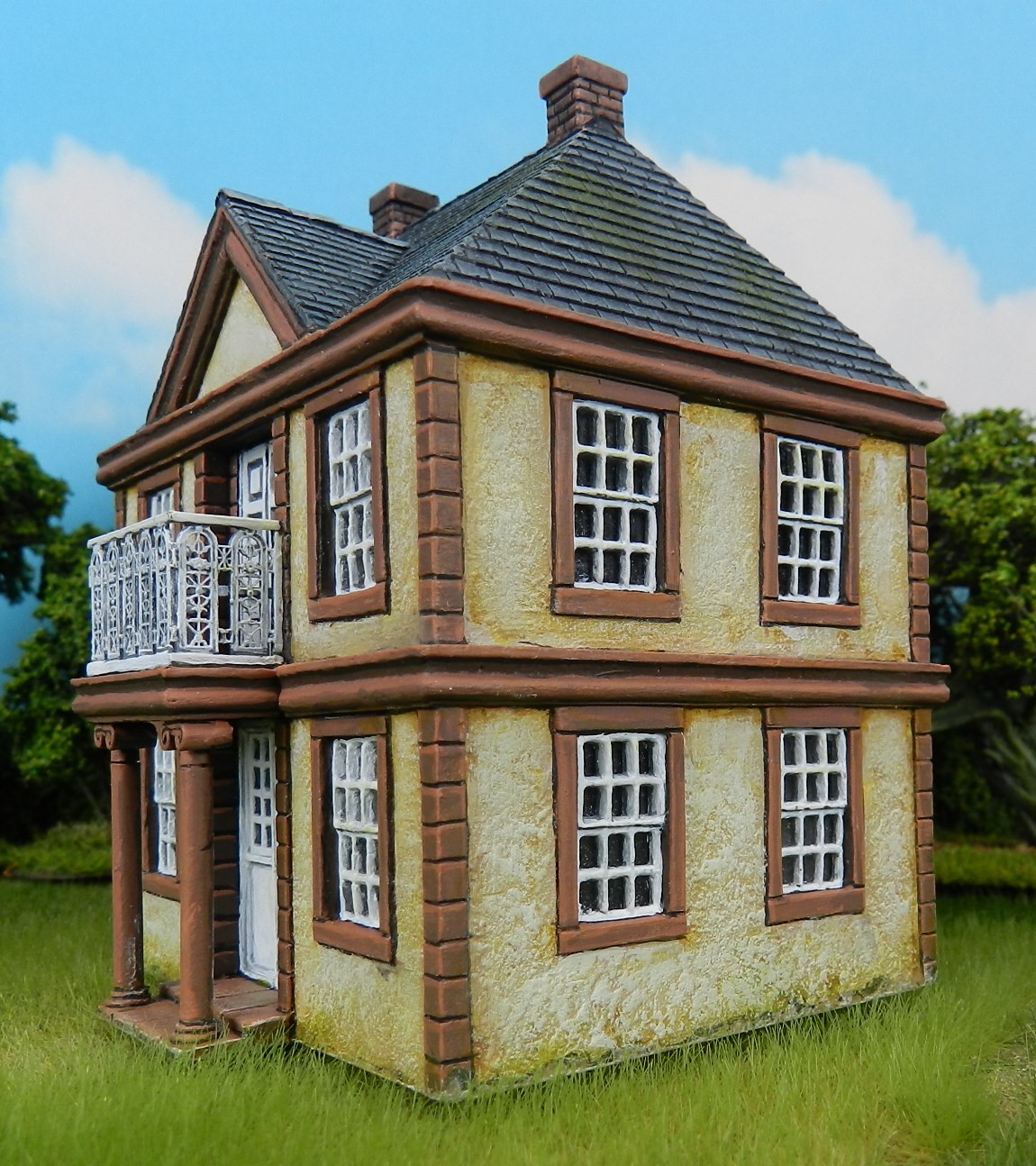
Having posted images now of most of the terrain I built years ago, here is my most recent effort, completed only a couple of weeks ago. It is part of a project to provide terrain for games set in the Franco-Prussian War of 1870-71. A sub-project within that greater one is to build several small chateau-type buildings. Most FPW battlefields had one or two such places, and they feature in the accounts as strongpoints being stormed at bayonet point. One battle (Coulmiers) actually had no less than six chateaus on it, but some of them were subsumed within villages so don't necessarily need modelling specifically. I decided three chateaus would cover things. Here's the first and I'm currently hard at work on the second.
I have long fancied making something in the French chateau line, as they are such nice buildings, deliberately intended to be pleasing and varied in appearance and in the larger cases impressive, with elaborate and stylish architectural features. Things being what they are of course, this desire rather clashes with the ground scale I tend to use, whereby a whole large battlefield is compressed onto a medium sized wargames table. For example in my FPW rules one inch equals a hundred metres, so a single building, even a big one, might scarcely be one inch square on its own!
But where there's a will there's a way. Studying the layout of these places I find they come in successive layers. You have the actual chateau building, but that's surrounded by an area of stables and courtyards, which in turn is enclosed within a "zone" of walled orchards and gardens several hundred metres in area. The whole thing was fought over in reality. (An example most wargamers will be familiar with is the chateau/ farm of Hougoumont at Waterloo.) I decided that I could make a nice building in my usual "condensed" style, representing the whole zone without doing too much violence to strict ground scales.
So off I went, starting with the smallest and simplest of the three chateaus planned, as something of a warm-up for the other two, which will be more elaborate. This one is in a gently neo-classical style, inspired by the Chateau of Duerckheim which stood in the village of Froeschwiller on the battlefield of that name (the one called Woerth by the Germans).
Monday, 1 August 2022
A Basque Town and Farm
A couple of weeks back I showed a not-very-good picture I had stumbled across of buildings from the Basque provinces of Spain. Those models were amongst the "ones that got way" as I lamented back in December, ie the models I'd made but hadn't photographed and no longer had access to. Since then I had kindly been sent some lovely photographs of the nice German village done for Jonathon Marcus. And now I have some decent pictures of the Basque models, so the only thing still missing from the record at this stage is the Trojan setup once made for Mark Sturmey.
The new photographs came initially from my friend Simon Chick, who had photographed them during a demo game at Salute 2014. But knowing now what show it was, I was able to search for other photos of the game. And I found them on two different blogs, called History in 1/72nd and The Lost and the Damned. (I tried to contact the owners of both blogs to check they didn't mind me reposting their pictures, but got no response in either case, from which I conclude there's no reason anyone would be bothered. Of course if I hear differently I will act as appropriate). Right, here we go.
Tuesday, 26 July 2022
Cobbled Roads
This post wraps up what I want to show in terms of the wargames road. This time we are looking at commercially bought latex roads, although I have improved them somewhat. I have got nothing against just laying out a bit of cash and buying terrain products when they are as good as I could do (or better), and will save me time. I did consider methods of making cobbled roads myself, and flattered myself I could have made masters, moulded them and "cast" latex roads in the same way as the commercial suppliers, but why bother when I only needed about 16 feet of them. So these are based on cobbled road sections produced by Early War Miniatures, which I chose because I liked the texture, but there are doubtless other makes equally good if you look around.
OK, it's time for another of my historical digressions I'm afraid. When I made the tarmac roads for the gangster era a few years back I researched the history of road surfaces, so to speak, because it seemed something that could be got right or got wrong, and because I do enjoy arcane knowledge sometimes. Obviously the "default" road up to the twentieth century was the unpaved, earth or "dirt" road, where the grass, etc was simply worn away by human and animal feet, plus the wheels of carts and carriages. Famously the Romans built many paved roads across their empire, which removed mud, puddles and the dust of summer. There were different systems, but all involved carved blocks of stone, so were extremely labour-intensive, often built by slave labour. Hence very few such roads were built again until something like the eighteenth century, and even then "chaussees" were few and far between, prestigious royal projects such as the "Kaiserstrasse" at the Battle of Kolin.
Around 1820 a British engineer called McAdam developed a method of building roads that was at least as good but much easier to build. It comprised basically layers of stone chippings, sometimes smoothed off with sand, and rollered smooth - it was what all those steamrollers were for. These "macadamised" roads spread rapidly across Britain and America, then other developed countries. So by the time of World War One, they were the main roads you would see, both in town and country. But motor vehicles forced another change, because their wheels sucked clouds of dust out of this type of road. So tar was spread on top, then very soon was mixed in with the sand and chippings to produce "tar-macadam", the "tarmac" roads that we see ever since the 1920's. The change was so sudden and complete that you can use it to date old photographs of your town or whatever: if the road surfaces are pale and dusty it's a macadam surface, so before about 1920, if it's dark and smooth it will be tarmac, so after that time.
Hence in terms of wargames scenery, you want mostly dirt roads with a few cobbled ones up to the Napoleonic wars. After that and up to WWI the main roads were macadamised, so would have a gritty texture and be pale grey or beige in colour. From the 1920's, tarmac is what you want. Knowing all this, I chose to ignore it for my Franco-Prussian War setup, because cobbled roads are much more widely useable for other wargaming periods! I might make some macadamed roads one day...
Saturday, 23 July 2022
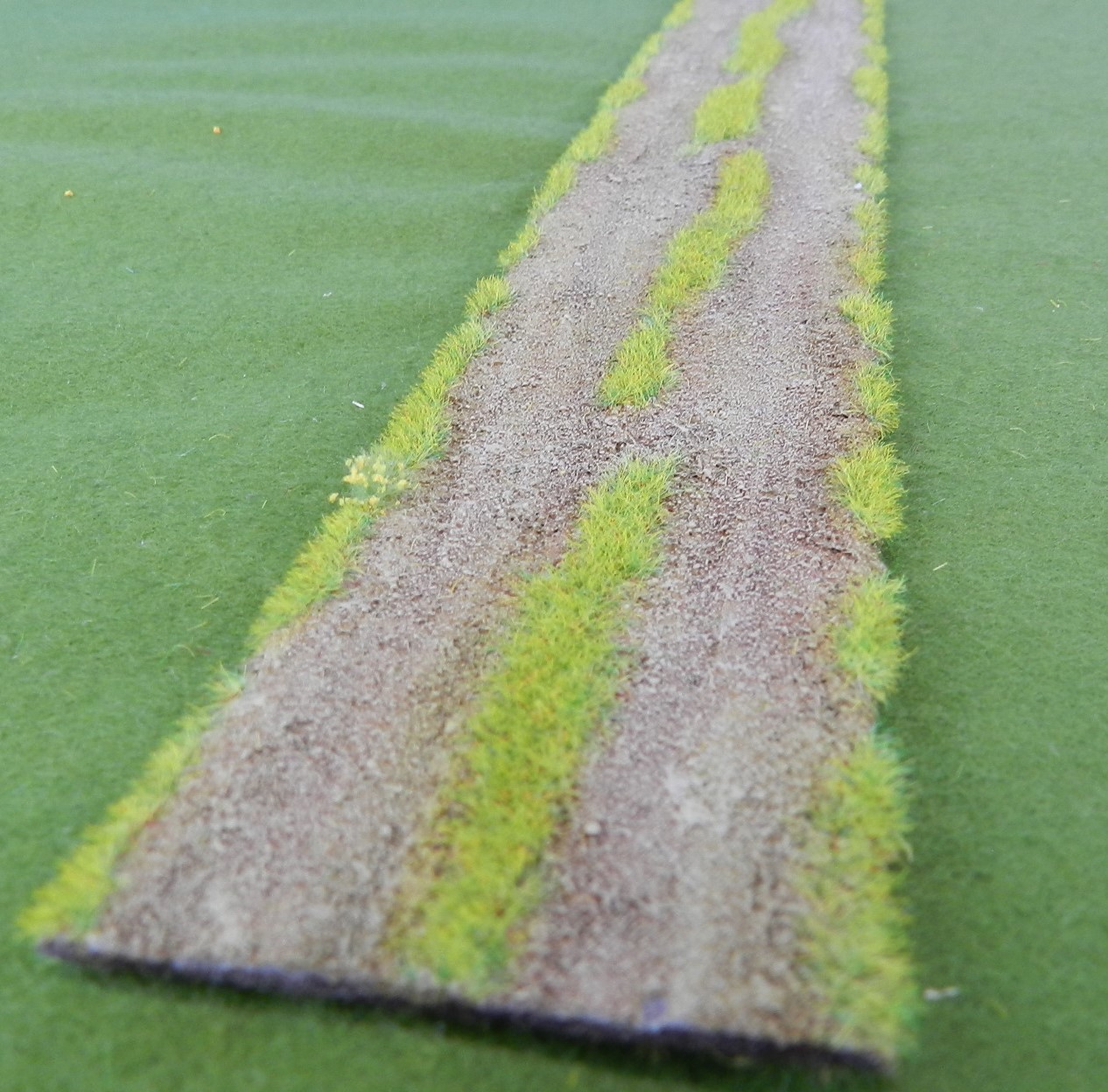
Flexible Dirt Roads made of Felt
Wednesday, 13 July 2022
A Little Find
Saturday, 2 July 2022
Flexible Felt Roads
I have added a couple of links for your interest: the printable sheets for 1920's city buildings, and the YouTube site for "OJ's Models". OJ does the most realistic 1:30 scale stone wall models I've ever seen, and I think you will struggle to tell them from the real thing. He explains his (admittedly labour-intensive) methods, which I will try in 28mm at some point.
Anyway, here's some roads I made for the 1920's gangsters to further endanger public safety by driving their their cars along at top speed. I made about sixteen feet of road using this method. Like the rest of the project, they didn't get 100% finished, but in this case I've decided to show them, as I think the method used is very useful for various types of road, as well as other terrain.
These pieces are made out of ordinary felt, the cloth mostly used for cuddly toys and the like. You can buy it in craft shops or online, either in rectangles or by getting say half a metre length from a roll of fabric, which gives you a massive quantity for £12-15 say. The colour you buy doesn't much matter, as it won't show in the finished product, but do get a lighter colour, as that will mark out easily with a ballpoint pen. It cuts easily with sharp scissors. The point of using felt rather than something rigid like mounting card is that the roads can easily be bent over any hills or irregularities on your tabletop, and will stay in place. The material also has a thickness of only 1-2mm, so isn't too obtrusive.
The technique is to cut out your road sections and paint one side with thinned PVA. You then cover that thickly with fine sand, gently shake off the surplus and go over it with a rolling pin to flatten it right down. A tarmac surface is more smooth than gritty, so you need only a restrained degree of texture. Once dry, I think I applied a black undercoat via a spray can, drybrushed with dark greys and spattered lighter shades on. The edges got painted an earth colour and a bit of static grass was applied. When I say these pieces weren't 100% finished, I meant to weather them a bit more with dust and grime, but didn't get that far.
I hope this approach is of interest to some of you. Would it work for unsurfaced roads, "dirt roads" as the Americans say? More or less, as we shall explore in due course.
-
I will soon have a second batch of French 1870 staff conversions to show you, but for now here is an article I wrote for the Foreign Corresp...
-
Hello everyone, I'm here today with some news and some photos of Franco-Prussian figures I converted and painted a little earlier this...