Sunday, 4 June 2023

More Work In Progress For The Battlefields Of Lorraine


More Lorraine WIP

It's been a while since I've posted on the blog, but here's what I've been working on: more buildings for the French province of Lorraine, where the decisive battles of the Franco-Prussian War (FPW) were fought out. Two churches a tavern and a kit-bashed factory, plus some "bits" to fill up the eventual village units.Time to get the paintbrushes out now. Comments on the individual images below. 

Partizan 2023

A few weeks back I enjoyed a day at the Partizan show with my friend Garry Broom. Bought a few things, not least a box of the new Perrys' plastic FPW French. I was touched to get a mention on the information sheet of the set "for additional flag information". Like their Prussian counterparts this is a great set, well proportioned and animated, with lots of choice and a good level of atmosphere and accuracy. I do worry what's happening to the range as a whole though, as it's a full year now since any metal packs were released. 

Talking of Perrys, we bumped into Alan P, who showed us images of the Napoleonic Ottoman cavalry he has sculpted but not released yet: mamelukes, dellis and other exotic types are all ready. It was also great to catch up with pals such as Dave Marshal and James Sharpe (both fellow wargames modelmakers), plus David Imrie, Phil Olley and a real blast from the past, Mark Copplestone, who was demo-ing his 1930's Little Soldiers. Mark is a bit of a leftie like me, and we had a great discussion about the part played by Frederick Engels fighting the Prussian army in the Baden revolutionary war of 1849! Obscure stuff alright.

I'm afraid I sometimes don't look very hard at demo games focussing on the American Civil War, which doesn't interest me much, but Dave Imrie drew me to a model within the game he and Dave Andrews were putting on: a beautifully detailed little lumber mill. We don't see as much from Dave A as we used to, which is a great shame because he has always been one of the very top wargames modellers. This sawmill was a delight, obviously based on study of a real example. It would be ideal for a Wild West game. I would really recommend you look out for this model in photos of the show.

The church of St Privat, a last stand in the churchyard of which forms the subject of about the best-known painting of the FPW, by Alphonse de Neuville. In a slightly "condensed" form this is what it looked like. It was burnt out during the battle and replaced by a new church elsewhere in the village, but the iconic churchyard gate still survives.

This church is based on the one in a Lorraine village called Bremenil. I used a Redutex textured sheet for the dome and it seems to have worked well, easily fitting the curve of the dome here.

When I studied modelmaking long ago we were encouraged to make a "sketch model" to work out the shape of the planned structure. It's not often I bother, but it seemed a good idea in this case, and helped me dodge one or two potential pitfalls. As you can see, it's just cheap card stuck together with masking tape. I kept it just to photograph and now it can go in the bin!

The scene of another favourite painting by de Neuville was the "Auberge du Croix de Lorraine", which you see here. You know, it's the one where a captured French agent stands defiantly before the Prussian staff  lounging around a cafe table! I've never worked out whether this was a real establishment or just an artistic excuse for the dramatic metaphor the painting comprises. At any rate there don't seem to exist any other images of the place whatsoever, so I had to guess everything that isn't in the painting.

Some Lorraine battlefields included early industrial buildings. I bodged this together from an old HO kit by a firm called POLA, "The Old Brickworks". I'd had the kit for 40 years, but it's still available online. Should paint up nicely and contrast with the more traditional buildings.

Finally some "bits": the cross and the pump of Rezonville and another village pump based on contempory illustrations. The first two feature strongly in the Panorama de Rezonville, painted by de Neuville and Edouard Detaille. These models were scratch-built out of styrene, brass rod and a bit of balsa. Pumps seem to have replaced village wells in the late nineteenth century.


Friday, 14 April 2023

Lorraine Houses Work in Progress

Hello everyone, here's another post, if not quite what I had planned. The intention was to arrange the pine trees, fir trees, coniferous wood bases and some Austro Prussian figures into nice scenes, just as folks out there in wargames-land seem to like best. But I've been very solidly locked into my project to populate the 1870 battlefield with villages, over the last couple of months now, and that's starting to bear fruit. So here's what I've been up to. There are seventeen houses for the Lorraine region built, leaving maybe four buildings to go before the paintbrushes come out: two churches, and inn and something industrial. After that there'll be some sort of village bases, a couple of detail items and perhaps some railway line. And then I'll be ready to refight a lot of the Franco-Prussian battles, from Spicheren to Rezonville.

Probably I've made this point before, but the FPW was fought over the whole of Northern France and each of the provinces had its distinctive local style of architecture. I did do some for the French Ardennes region twenty years back, but they are a bit drab and I felt I could make something better now, so had to decide between the vernaculars of the half a dozen regions remaining. There is no "generic French" look, as wargamers like to think, or certainly not before the twentieth century. This was my thinking, after discussions with gaming friends:

  • Alsace? Lovely half-timbered buildings, would serve for Germany, but b*****s to build and only two FPW battles happened there. And we've already refought one of them (Wissembourg). 
  • The Somme/ Northern Front? Tempting, because we've been playing out the adventures of the Armee du Nord, but there weren't many battles and the armies were very unevenly matched.  It was all snowy when the battles happened, and I'm not ready to build winter woods and all the rest of it.
  • North of Orleans? Same issues really, even though more battles happened there.
  • Around Paris? Same issues again.
  • Franche Comte/ Belfort? Same again, but even more so.
  • Lorraine? The most dramatic, decisive battles were fought here, with the armies "fairly" balanced. The style is a little plain, but I was inspired by the paintings of Alphonse de Neuville, and especially the Panorama of Rezonville. And I thought the rendered, pantiled houses would do at a pinch for something in Spain or Italy some day. So that was the decision.
As you will know if you have read earlier posts, my quirky approach to wargaming is that I want to do quite big battles, on a normal sized table (6' x 10' max) and with 28mm figures. So this means a very small groundscale, an inch to 100 metres in the FPW case, hence a village is only maybe 100mm square. So we can only aim to have a couple of small buildings a tree or two, a well or something and a little bit of garden wall. Now that can evoke a village very pleasingly if done right, and you can have a dozen of them on the tabletop. But the upshot is each building has to be distinctly "condensed", as I've discussed before. Some wargamers don't "get" this approach, but it would be a dull world if we all thought the same, as they say. 

Anyway, small buildings, but lots of them, historically accurate, detailed and individually varied works for me. I researched the Lorraine style quite thoroughly, then made plans, built master models for individual components, moulded them and cast what I would need. Then I set about putting things together, working to ensure each house was different to the next.

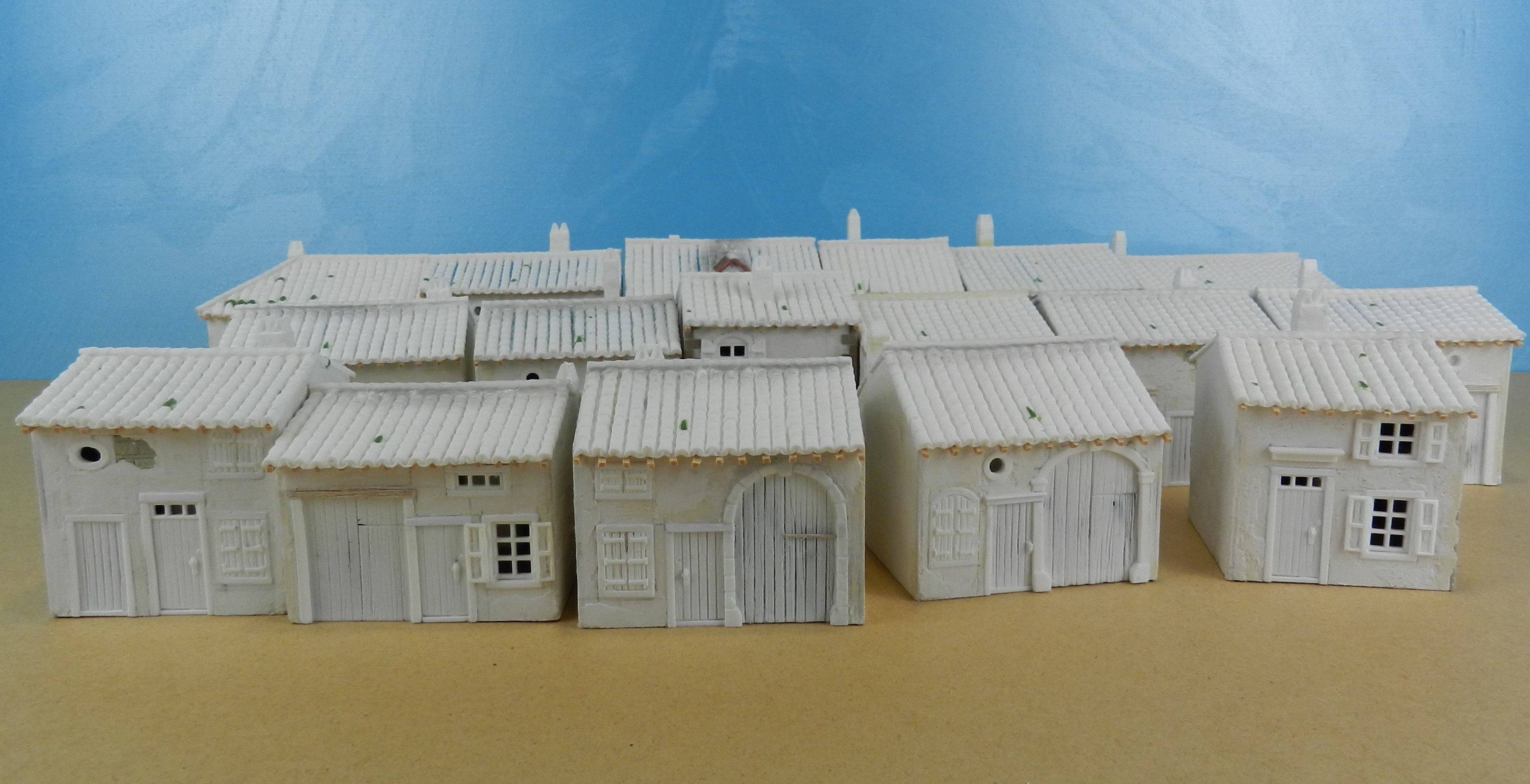
Here's the whole lot together. You're seeing the fronts of buildings, with the characteristic barn doors. The shape of each model is made from mounting card, cut out for the doors and windows, and roofed with a cast sheet of the correct "canal" pantiles. (Or you could use the Wills or Redutex pantile sheets). The dark spots you see are little alterations or corrections done with green stuff.

A real Lorraine village consisted of the houses built in a row either side of the street. The area in front of each house comprised its farm yard, with piles of wood, muck heaps and whatnot, but we won't be able to show that in practice.

The backs of the houses were quite plain. In reality there were bread ovens, pigsties and outhouses there, but I can't spare the ground area to show that. 

Typical facades. One side of the house is for living in and the other is agricultural. I made three types of door, three barn doors, three chimneys, windows with shutters open and closed, and with flat and rounded tops. A quirky local feature is the vertical posts of doors and windows being combined into one stonework column. And another is the round or oval "portholes" which ventilate a hay loft.

Houses at the end of a row could have hipped roofs as here, or semi hipped. In this situation there could be doors and windows on the end wall, which you otherwise don't have. Being one of the slightly larger houses, this one has a third, middle, door on the front, which would open onto a corridor leading to a stable or cowshed behind the barn area. 
Dormer windows were rare in this region of France, but seen occasionally. The pencil arrow on the barn door was a reminder to myself to fix a hole that appeared in the casting. 


Squeezed between the larger farmhouses were dwellings with no provision for farming. This one is "up-market", with dressed quoins (corner stones), nicer details and an alcove above the door containing a statuette of the virgin Mary. Lorraine was as devoutly catholic as most of rural France. The Duchy suffered terribly in the Thirty Years War, and if you know the series of engravings "The Miseries of War" by Jacques Callot, it is actually Lorraine he depicts, and you will recognise the same style of building as in 1870. 


Friday, 24 March 2023

And Fir Trees

 Work In Progress

I've been a bit slow to post, once again, but can honestly claim this is because I've been busy making historical buildings. Not just busy, flat out in fact. What I am working on is the components of Franco Prussian War villages. As I might have mentioned before, the FPW was fought across most of Northern France and the style of buildings was very different in each province. Hence there is no such thing as "generic French" vernacular architecture! You have to choose one area and go for it. I've plumped for Lorraine, as will be explained later, and am busy with the buildings, to be followed by village bases and surrounding walls. To do what I want in terms of quite big battles I reckon I need some twenty new structures, so mass production is under way. The research and planning are done, I've made masters for local types of window, chimney, etc, made moulds and cast almost 400 resin components. Eleven houses are nearly complete at this point. I'm finding it quite a satisfying process, and will get some "WIP" shots when I next take photographs.   

Plans for 2023

Generally I find it's a bad idea to come out with big plans and then fall distinctly short. So most of my goals for 2023 consist of things that were planned but didn't get done in 2022. There's five objectives:

  1. Lorraine villages. Umm, will need some basic railway lines to go with this environment.
  2. Prussian and French staff groups, as mentioned before. Quite a lot of mounted figures, mostly major conversions.
  3. A playing table which looks decent and enables us to set up any configuration of hills and valleys. This will have three elements. Firstly a system of blue foam hill underlays, which I did  actually complete in the New Year. Then a set of boards covered in blue foam sheet which the hills can be pinned to. And finally a good cloth (teddy fur probably) which will cover the whole.
  4. When the Perrys plastic FPW French finally come out I won't be able to resist doing at least a couple of units, though must withstand any thought of replacing huge existing armies of Foundry FPW figures!
  5. The third chateau of the planned trio: less eleborate than the baroque affair, but based on a former medieval castle. Such a chateau featured on several FPW battlefields, and was the prime focus of the Battle of Villepion.
If, if, if I can get this lot done, then I want to move on to a new wargames period in 2024. And have real go at modelling rivers maybe.

The Fir Trees

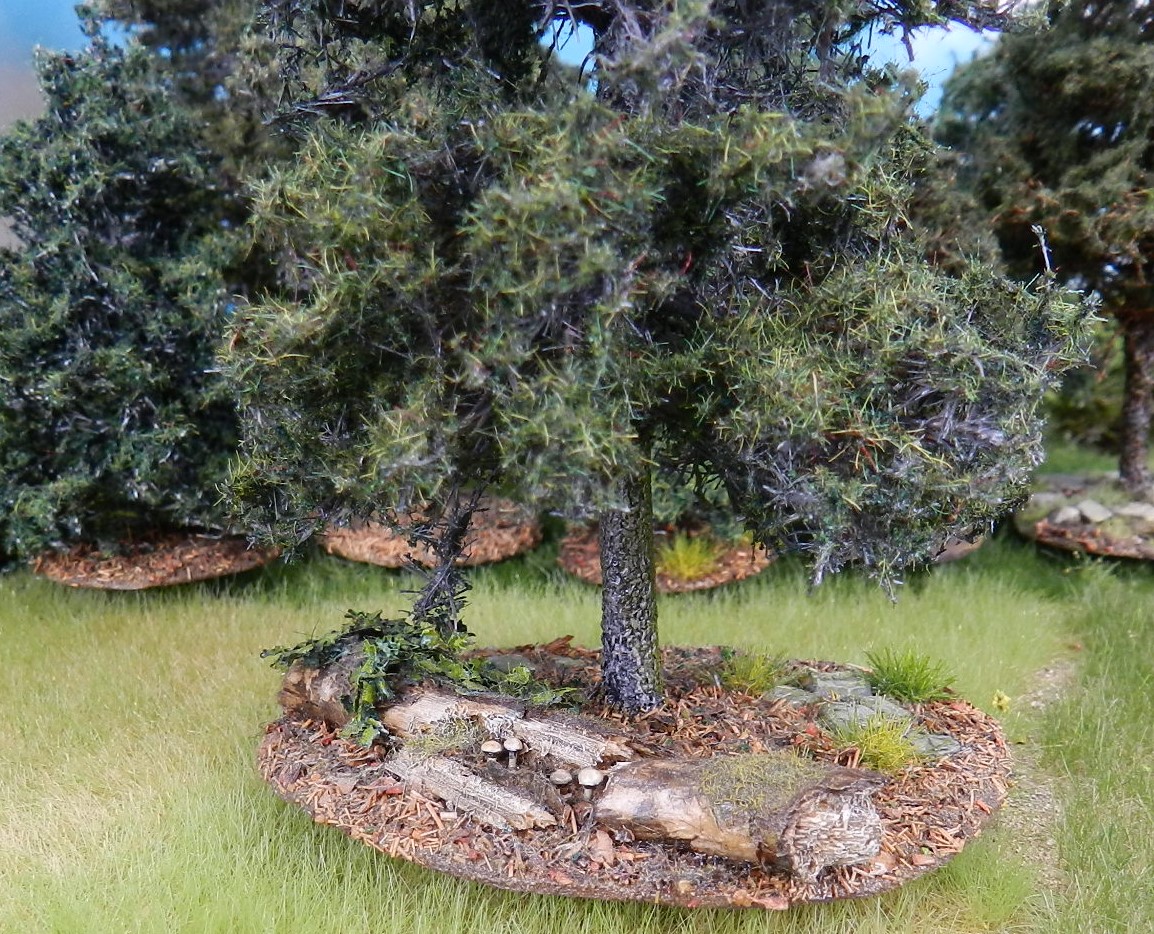
Finally the pretext for these ramblings, the fir trees which I made along with the previously-seen pines in about 2012. These were mostly made by the "bottle brush" method and then set into short sections of twig for the trunks, the leaves/ needles being static grass. I experimented with one or two different approaches, but they all ended up looking similar. Once again some trees are based and some on pins. 

As individual models I wouldn't say these trees are my finest-ever productions, but they group together into woods which look the part. There's a couple of details in the photos below. A pair of trees which appear to grow into one, which seems to be a thing with fir trees. And an eleborate base with a rotting, ivy-covered log and mushrooms! The latter are just the tops of pins, so a tiny detail that's easy to make.

Overall I've got about 40 freestanding pine and fir trees, which go together on flexible wood bases. Because coniferous woods, even more than deciduous ones, are very often on the slopes of hills. It was making these which got me started with using felt for games terrain. I'll photograph the overall effect for the next post.


Tuesday, 28 February 2023

Pine Trees

Hi everyone. Here we are with another post, this time the pine trees I made for the Bohemia 1866 setup. I also made fir trees and the coniferous wood bases onto which both go, which will form the subjects of two later posts. I took the photos of both kinds of trees, then selected and cropped these images before realising I hadn't posed any figures with them. I know you chaps like to see that, but this time we'll have to do without.

I made these trees maybe 11 years ago, and for some reason, perhaps not unrelated to advancing age, I can't remember too much detail about how I made them. Roughly what you are seeing here is trunks made from dowel, topped with branch-ey parts made from twigs and / or Woodland Scenics tree armatures(?) The dead lower branches are lengths of wire, inserted in holes drilled through the trunk. The branches were then expanded by gluing on small pieces of well teased-out rubberised horsehair. The leaves/ needles were mostly static grass. I think I could do that element somewhat better now as I have a powerful grass applicator and could perhaps source short, dark green static grass more easily. But there we are, because I made over 40 pine and fir trees and I'm not fixing to do any more in the near future!

Those who've followed my blog may remember me saying very firmly that I thought it unwise to research individual species of trees, beeches, elms and what-not, because that was a trouble that wouldn't add anything to the appearance of the wargames table. But when it came to coniferous trees I thought this principle needed to be contravened, because we all have at least vague concepts of the things in our heads. Scots pines are one thing, Christmas trees quite another! So I did look into different coniferous types. The upshot is they come in roughly four flavours, at least in Europe: pines, firs, spruce and larch. The latter two have drooping foliage, which could be modelled with the (expensive) materials produced by Mininatur in Germany, but I preferred to stick with the other two. 

So pines are the ones with long trunks and bushy foliage at the top. The lower trunks are greyish and very rough, but that on the upper, growing parts is smooth, and quite a bright brown in colour. So that's what you've got here, as best as I could do it. One more feature that seems common with conifers is dead areas, caused either by insects or by lightning strikes. I modelled one such patch by fixing on a sagebrush twig. As usual I've made some trees on bases and other mounted on pins; both are useful for the wargames wood. 

As I have already photographed the fir trees, a post showing them should be up a bit more promptly than this one. Hopefully a week or two hence.


Thursday, 2 February 2023

The Complete Bohemian Village Units

Once again it's been a few weeks since I've managed a post on here, and once again the excuse is that I've been working hard on my Franco-Prussian War rules. What also didn't help me get around to it was knowing this post was going to be quite a lengthy job. I wanted to  put together all the Bohemian buildings in their village units as intended, and also show the 1866 figures that haven't yet been featured. You've seen my Austrians more or less, and some of the Saxons and Prussians, so here are the rest. Come to think of it, my Prussian cavalry and staff still seem to have escaped the net. But I've still got to photograph some coniferous woods made for this campaign, so will drag the missing figures in there. And then I'll be done with showing my past work and we will be moving on to new efforts and the long-promised tutorials. 

These shots show pretty much what I wanted to do with the appearance of 1866 wargames. The soft greenery and the dull colours of thatch and woodwork set off the bright uniform colours rather nicely I think. 

Prussian infantry  of IR58 double through a Bohemian village.

Here and in the next photo Saxon infantry of the Life Brigade march though another settlement at a more measured pace. In 1866 the Saxons managed the trick of gaining praise from both Austrian allies and Prussian enemies without either suffering great casualties or particularly knocking themselves out. 

Saxon flags were remarkably consistent over the years: a coat of arms and an elaborate border did the job distinctively. On the other hand they managed to get through five uniform colours between 1735 and 1867: red coats, white ones for a long time, green briefly, mid blue here and finally dark blue! By the way, my Saxons are all conversions, mostly from Perrys plastic French and ACW line infantry.

Here the Saxon second brigade defends a chateau. Like most of the German states each brigade comprised four line battalions and one of Jaegers.

And here are the Jaegers, apparently defending the rear of the same village. You've seen this stand before, but I like the poses, so not apologising.

Here a Prussian brigade defends another village.

Thes figures are mostly Helion/ North Star 1866 figures, but there's some heavy conversions amongst them.

Another unit marches steadily towards the foe, although the general wants them to hurry up. He's coverted from a Perry ACW general. Such chaps are rich conversion fodder for Prussian staff as they share both frock coats and copious facial hair.

Saxons defending again. Probably the secret of their good reputation and low casualties was that they did a lot of defending rather than headbanging bayonet charges like their Austrian allies.

Prussians defend yet another village, no doubt against a hopeless bayonet charge. At least they are taking a bit of Austrian artillery fire.

And in the last three photos is my 1866 Baden division. Not many wargamers have one of them, I think it's fair to say. I started to do the German Federal armies for this period, but only got as far as the Badeners, who are quite easy conversions from Austrian infantry. 

Both brigades were made up in the way described above, ie four line battalions and one of light infantry. The Badeners only had one Jaeger battalion, so made up the shortfall with a Fusilier unit.

It's a colourful period, isn't it?


Thursday, 12 January 2023

Bohemian Chapels and Shrines

Today's post shows the various chapels and shrines I built for the Bohemia 1866 setup. The land was crammed with such Catholic symbols, in villages and by the roadside. In this post they are something of a prop for more of my heavily-converted 1866 figures.

We start with a chapel, made by the "cannibalise a plastic kit" method discussed last time. The gun is a 12-pounder smoothbore of the Saxon horse artillery. The Prussians and pretty much all the German states equipped their horse artillery with such guns, fancying they would mount "grapeshot charges", but the tactic was a non-starter in the face of Austrian rifled artillery.

Another chapel, made in the same sort of way. This gun is a Saxon 6-pound rifled breechloader. The foot artillery of all the German states comprised these pieces and smoothbore 12-pounders, in a 50:50 mix. The 6-pounder barrels were made by Krupp, but each state built its own carriages to mount them on.

Even a village might have a religious statue like this. The figure on top came from the Faller set of religious details. Austrian Jaegers pose by the statue. I converted them from Perry ACW firing line guys. There is a teeny bit of evidence that, unlike the line infantry, the Jaegers sometimes fought in their "proper" uniform rather than the drab greatcoat, so I needed no more excuse.

Here a Saxon general and a mounted colonel pass a little model of a cross and a "village bell". Bohemian villages, presumably the ones lacking a church, invariably had such a bell. I think its function was to summon the villagers in the event of a fire or whatever.

Saxon Jaegers fight there way into a Bohemian village, past one of the many varieties of shrine. You may just be able to make out a statue behind the grille. The figures started life as plastic French Napoleonic voltigeurs.

Another village, another shrine, another battalion of Saxon Jaegers. 

And another shrine, this one recognisably in the local version of Baroque style. Beside it stands the the commander of my 1866 Prussians, General von Steinmetz. He wears his famous oilcloth-covered field cap, which he'd worn in the Napoleonic wars as a young officer! Steinmetz was a dead loss in the Franco-Prussian War, but in 1866 he was the hero of the army. He led his V Corps to defeat three successive Austrian corps on three successive days, whilst uttering bon mots under the heaviest fire! Accompanying him are his chief of staff and a dismounted officer of the Guard Cuirassiers. The latter wears an odd but characteristic outfit: bronzed cuirass, field cap, high boots and a frock coat turned back in Seven Years War style! His horse is held by a trooper of the Feldgendarmerie.

The heroes of the Austrian army were the gunners. Here we have a the massed corps artillery: a 4-pounder battery, a double battery of 8-pounders, a double battery of horse 4-pounders, the rocketeers and the artillery commander. These two shrines are mounted on pins.


Sunday, 1 January 2023

A Chateau in Bohemia


Happy New Year!

I hope you had a good Christmas. Happy New Year at any rate. I have been laid low by the virus that everyone around has been getting. Is it Covid, flu or some nameless monster bug? Doesn't seem to make much difference at this late stage of the pandemic. I've had worse flu in the past, so it's nothing like the lethal early variants of Covid, but you get a kalaidescope of symptoms from day to day, linked throughout only by low mood and zero energy. Anyway, I'm about as normal as I get now, so on we go with the next photos from 1866 Bohemia.

Review of 2022

First a bit of a review  of 2022's hobby activity might be in order. I am a big believer in working towards objectives, and I set myself three for the year: Franco-Prussian War rules, finishing the armies for that period and making a really good (teddy-bear fur) cloth to cover my table. And then two other priorities forced their way onto the list: Franco-Prussian buildings and two more artillery masters for Michael Perry. This last job was the only one of the five targets definitively ticked off, the masters being handed over six months ago now. The cloth project has got nowhere as yet, although I have the beginnings of a flexible system of hills to lay beneath it (which I'll talk about another time). So that leaves three goals on which there's been concrete progress, but there's some distance to go as yet. 

Firstly the FPW rules. This time last year only concepts existed and a fully playable set has seen action maybe a dozen times since then. It's fully typed up and copies have been sent to those of you who asked. Feedback was received and incorporated from Garry Broom, Adrian Hussey, Nathan Paxton, Jonathon Marcus and Martin Gane. I did approach Richard Clarke of Too Fat Lardies with a view to discussing publication. He said at the very least he'd read them and give me feedback, which I would very much have welcomed. Sadly he then decided it wasn't a commercially viable period for the investment required and never gave me any feedback. Which I thought was rather disappointing of him. I have faint ideas of  approaching maybe Helion or someone. I'm still slowly refining the rules, so we'll see. Actually, I should say, I am quite chuffed with getting these rules done, because I had wondered whether my ageing brain would be up to it. Well it is. So far. Touch wood!

The main job as regards finishing Franco-Prussian armies is to do the staff. Because of the army level at which the game is set, we need command groups for armies, corps, divisions and a few lesser folk. Although our forces for this war are made up from the old Foundry range, we thought that staff from the new Perrys range would be reasonably compatible. Sadly 2022 has seen only a single pack of Prussian "high command" released, half of which are completely inaccurate (sorry to moan). So we can't do anything for the French as yet, whilst German command groups will be "heavy" conversions. At least I've done the necessary figures for the Bavarian corps, which you've seen. The Prussians will be feasible, but any French will have to wait for some actual releases for that army.

Finally, as you have seen I've built a few earthworks and two chateaus for this period. There's another chateau planned, plus village buildings and some other bits and bobs such as railway lines and vineyards. 

Apart from these making and painting targets, I have kept this blog going, with some 40 posts in 2022. There's been some great feedback and comments from readers, and I've been able to provide advice to a number of people with scenery projects of their own. Some of this has been via email rather than comments on the blog, which is fine. I have now photographed almost all of my earlier projects and after about another four posts on Bohemia, it will be current work and the long-promised tutorials. 

The Bohemian Chateau

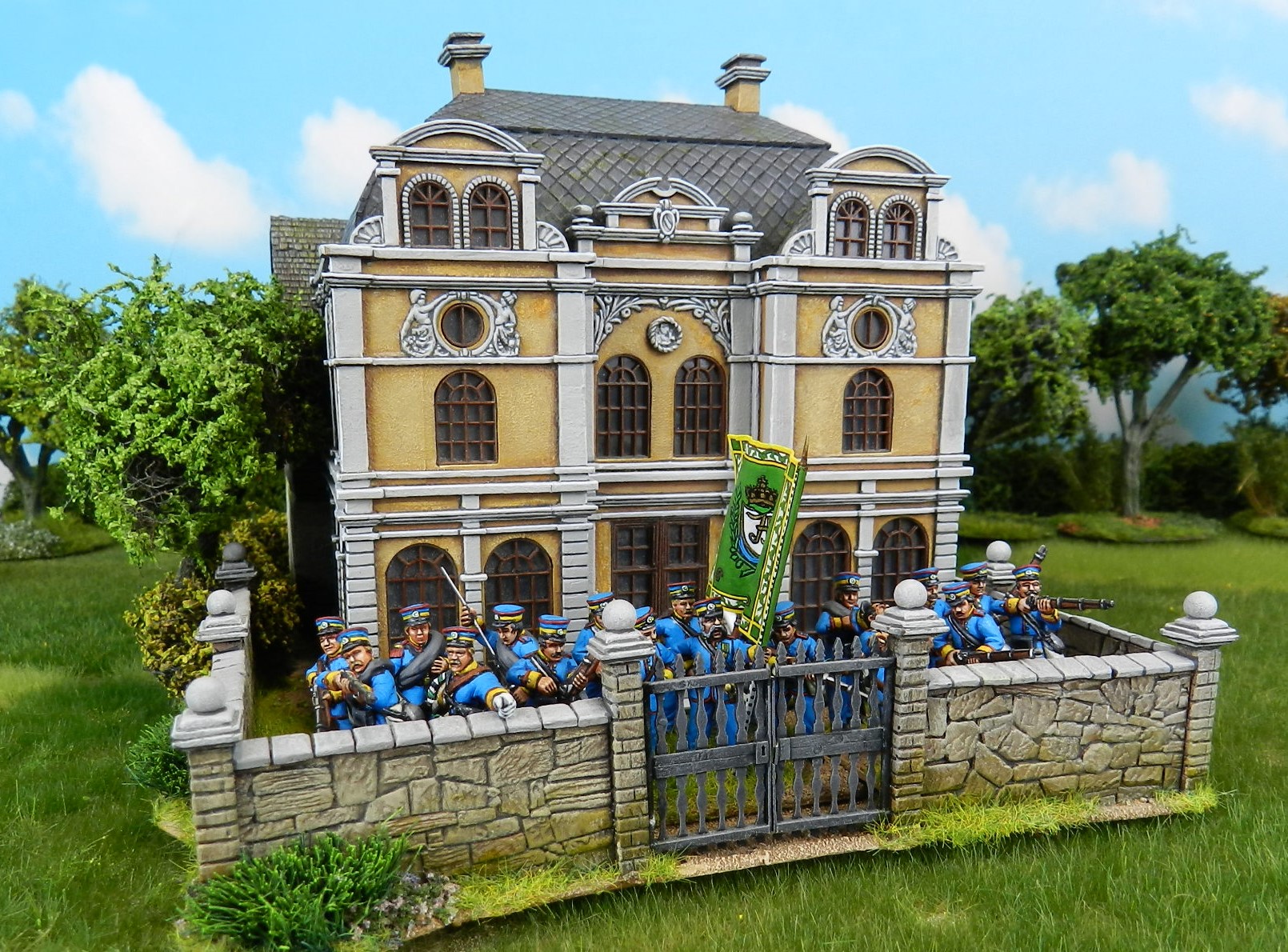
Right, back to the nitty-gritty. I built this chateau some ten years ago. Unlike the recent  French baroque effort which was a major scratch-build, this building was a sort of conversion, a "mash-up" perhaps, of a model railway kit. The original was Baden-Baden railway station, an HO (1:96) production from Vollmer, which you can easily find online if you're interested. I was lucky enough to find a half-made, grotty version of this kit being sold cheap at a model railway show some years earlier, and had thought it might be the makings of something grandiose one day. 

The technique of taking a model railway kit and using it to make a wargames model of a somewhat different scale was one of the useful things invented by the late Peter Gilder. These kits can provide a ton of useful detail such as windows and ornamentation. The two buildings in my last post both got their roofs from plastic kits. Mostly you have to buy these kits new and they aren't particularly cheap (though Ebay may help), but they save a lot of time and can provide something different, plus it's a good approach for the less confident modelmaker. Simon Chick ran with this approach, as you may see on his Je Lay Emprins blog (link in right-hand column). The key thing, which Peter Gilder noted, is to get at least the ground floor and any doors to a height that looks something like compatible with the figures you are going to use. The upper storeys aren't so noticeable. 

In this case, I made the basic walls from scratch, so basically the parts coloured ochre, cutting window openings to fit the kit part and cutting kit details to fit on top. The roof is made from cut-up roof sections of the kit. A few parts such as chimneys and stairs are scratch-built. 

The architectural style of Baden's railway station, and hence this chateau is what's called "rococo". This look was an ornamental development of the baroque style we have talked about before, starting in  France during the early eighteenth century. For some reason it lasted longest in Germany, and hence the Austrian Empire. Rococo style is fussy and flowery, cupids being the signature detail!


Here Austrian uhlans and hussars show off their own fussily-detailed style. Although to be fair there's no cupids.

An Austrian Grenz regiment, in this case Number 13 Roman-Banat. Grenz infantry had been classed as light troops right up to the war of 1859, but in 1866 were just seen as slightly unreliable line troops and mostly used for garrisons. The parade uniform had brown tunics, which you only see on the officer here.


The Austrian rocket launcher used in 1866. By this time they worked on the unspectacular Hales system, ie spin stabilised, no longer the "firework rocket" approach. Also by this time rifled artillery had made the rockets relatively short-ranged. They hoped for a certain morale effect, but this was lost on the stolid Prussians! The only remaining advantage from this weapon system was that it was transported by pack mules, so could go up mountains and through woods unlike conventional artillery.


Austrian gunners run up a 4-pounder. Conversions from Perrys ACW gunners. These pieces were the final and optimal development of bronze muzzle-loading artillery. All the barrel-bands, dolphins and the rest of it were stripped away, leaving a simple, accurate, long-ranged and very light artillery piece.